
This manual provides installation, safety, connection, operation, and maintenance instructions for Bühler Technologies' 222.xx series sampling probes.
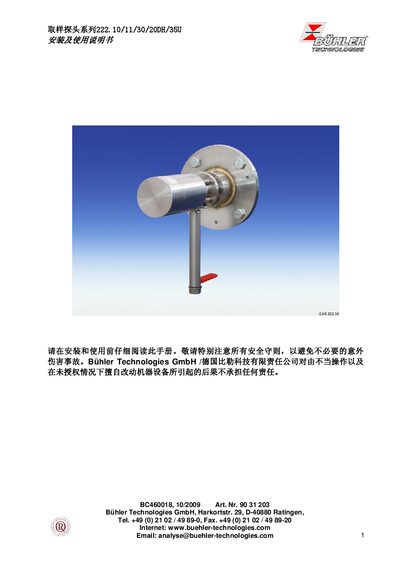
The document explains the purpose and safety requirements for the 222.xx series gas sampling probes. It emphasizes reading all safety rules, installing the equipment in explosion‑proof zones, and using only original parts.
It then details the installation steps, wiring connections, operation procedures, maintenance tasks, troubleshooting, and disposal guidelines. Additional tables list chemical resistance, part numbers, and optional accessories. This manual is written in Chinese.
| Maximum working pressure | 10 bar |
|---|---|
| Maximum working temperature | 50 °C |
| Storage temperature range | –20 °C to +60 °C |
Read all safety rules, ensure the installation location meets relevant safety regulations and technical instructions, and use only original parts.
The blow‑off gas tank is rated for a maximum working pressure of 10 bar (145 psi).
Store the probe in a dry, dust‑free, protected space with a temperature between –20 °C and +60 °C.
All basic probe components meet the requirements for Zone 1 and Zone 2 environments; some accessories are limited to Zone 2.