
User manual for the JS-1 and JS-4 water‑immersion transmitters, covering specifications, wiring, installation and selection.
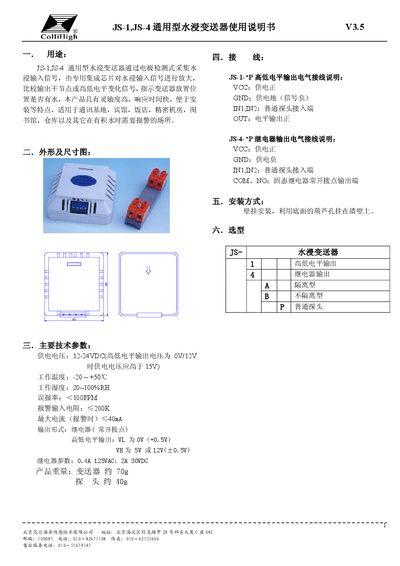
The JS-1 and JS-4 are general‑purpose water‑immersion transmitters that detect water‑infiltration signals via electrodes and output either voltage level or relay contacts. They are designed for high sensitivity, fast response, and easy installation in locations such as communication bases, hotels, and precision server rooms.
The manual provides technical parameters, wiring diagrams for both voltage‑level and relay versions, wall‑mount installation instructions, and guidance on selecting the appropriate model based on output type and probe configuration. This manual is written in Chinese.
| Supply voltage | 12‑24V DC (must be >15V when output is 0V/12V) |
|---|---|
| Operating temperature | -20 °C to +50 °C |
| Operating humidity | 20 % to 100 % RH |
| False alarm rate | < 100 PPM |
| Alarm input resistance | ≤ 200 kΩ |
| Maximum alarm current | ≤ 40 mA |
| Output form | Relay (normally open contacts) |
| High/low level output voltage | VL = 0 V (±0.5 V), VH = 5 V or 12 V (±0.5 V) |
| Relay parameters | 0.4 A 125 VAC; 2 A 30 VDC |
| Product weight | Transmitter ≈ 70 g, Probe ≈ 40 g |
It operates from a 12‑24 V DC supply; when the output voltage is 0 V/12 V the supply must be higher than 15 V.
The device is wall‑mounted by using the bottom mounting hole to hang it on the wall.
The false alarm rate is less than 100 PPM.