
The CH283 photon counting light detector from Beijing BinSong Photon Technology is a low‑noise, TTL‑output sensor for weak light detection.
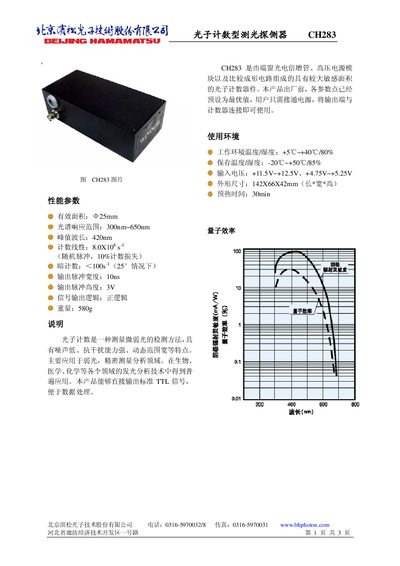
The CH283 is a photon‑counting light detector with a large 25 mm effective area, designed for low‑noise, high‑dynamic‑range measurement of weak optical signals in biological, medical and chemical analysis. It outputs a standard TTL signal for easy data processing.
This manual provides performance specifications, operating environment limits, wiring instructions, safety precautions, and troubleshooting guidance. Users are instructed to connect the BNC output to a counter, supply the required voltages, and follow the recommended storage and handling procedures. This manual is written in Chinese.
| Effective area | Φ 25 mm |
|---|---|
| Spectral response range | 300 nm–650 nm |
| Peak wavelength | 420 nm |
| Counting linearity | 8.0×10⁶ s⁻¹ (random pulse, 10% loss) |
| Dark count | < 100 s⁻¹ (25 °C) |
| Output pulse width | 10 ns |
| Output pulse height | 3 V |
| Signal output logic | Positive logic |
| Weight | 580 g |
| Operating temperature / humidity | +5 °C–+40 °C / 80 % RH |
| Storage temperature / humidity | -20 °C–+50 °C / 85 % RH |
| Input voltage | +11.5 V–+12.5 V, +4.75 V–+5.25 V |
| Dimensions | 142 mm × 66 mm × 42 mm (L×W×H) |
Supply the detector with +11.5 V to +12.5 V (or +4.75 V to +5.25 V) as specified in the manual.
Operate the detector at +5 °C to +40 °C with up to 80 % relative humidity.