
BASF Hydropalat WE 3987 nonionic surfactant safety data sheet covering hazards, composition, first aid, storage, physical properties and transport.
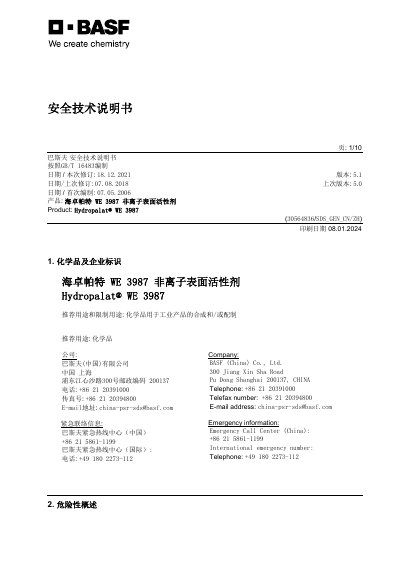
This document is a Chinese safety data sheet for BASF Hydropalat WE 3987, a nonionic surfactant described as a polymer of propylene oxide and ethylene oxide. It was prepared according to GB/T 16483 and covers identification, hazards, composition, first-aid, fire-fighting, handling, storage, exposure control, physical and chemical properties, toxicology, ecology, disposal, transport and regulatory information.
The product is not classified as hazardous under GHS and is not classified as a dangerous good for transport. Recommended storage is in a sealed, dry, cool place at or below 40 C, protected from temperatures above 30 C. This manual is written in Chinese.
| Chemical nature | Polymer of propylene oxide and ethylene oxide |
|---|---|
| CAS number | 9003-11-6 |
| GHS classification | Not classified under GHS |
| Storage temperature | <= 40 C |
| Temperature protection | Protect from temperatures above 30 C |
| pH | 5 - 7.5 (25 g/l) |
| Melting point | Approximately 49 C |
| Flash point | Approximately 244 C (ASTM D92) |
| Density | 1.04 g/cm3 (77 C) |
| Bulk density | Approximately 600 kg/m3 (DIN ISO 697) |
| Water solubility | Soluble |
| log Pow | -1.58 (calculated) |
| Dynamic viscosity | 700 mPa.s (77 C) |
| Molar mass | 7,700 g/mol |
| Vapor pressure | < 0.1 mmHg (25 C) |
| Acute oral toxicity (rat) | > 2,000 mg/kg |
| Biodegradation | Approximately 70-80% of theoretical CO2 in 28 days; readily biodegradable |
| Transport classification | Not classified as dangerous goods |
According to the GHS standard, the product does not need to be classified and does not require a hazard warning label.
Keep the container sealed and dry in a cool place, store at or below 40 C, and protect it from temperatures above 30 C.
It is readily biodegradable, with approximately 70-80% of theoretical CO2 formation in 28 days.
It is not classified as a dangerous good under transport regulations.