
Technical manual for Bar'sLeaks AC-1 fluorescent sealant that repairs small leaks in automotive air‑conditioning systems.
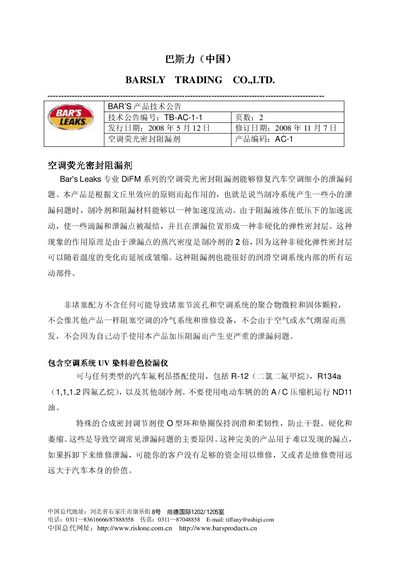
The Bar'sLeaks AC-1 fluorescent sealant is designed to stop tiny leaks in automotive air‑conditioning systems using a non‑hardening elastic seal layer based on the Venturi effect. The product contains a UV‑visible dye that helps locate leak points under ultraviolet light.
The manual provides usage instructions, recommended dosage, applicable components, and detailed product specifications such as bottle capacity, dimensions, and packaging. It also explains how to apply the sealant, perform UV leak detection, and when mechanical repair may be required. This manual is written in Chinese.
| Bottle capacity | 2 fl oz (59 mL) |
|---|---|
| Bottle dimensions | 1.4 × 1.4 × 3.7 inches |
| Net weight (inner packaging) | 1 lb |
| Gross weight (outer packaging) | 2 lb |
| Customs code (HS) | 3403.11.9900 |
It can be used on condensers, evaporators, hose joints, O‑rings and gaskets.
For a system holding about 2.25 kg of refrigerant, one 2‑ounce bottle is recommended.
The UV dye fluoresces under ultraviolet light, showing green or yellow at leak points to help locate otherwise invisible leaks.
It works on the Venturi effect, where accelerated flow of refrigerant and sealant creates a non‑hardening elastic seal at leak points.