
A practical guide for computer network lab exercises covering hardware, Linux commands, IP addressing, routing protocols, and server configuration.
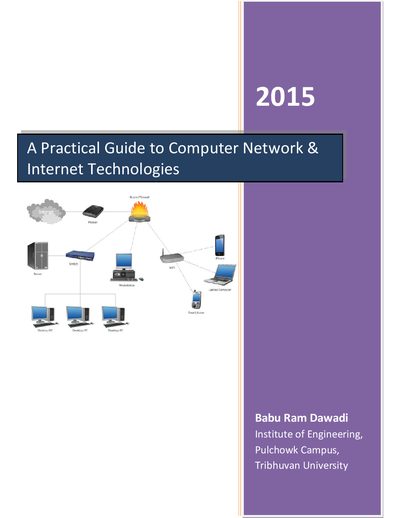
This manual serves as a practical guide to computer network and internet technologies, designed for students at the Babu Ram Dawadi Institute of Engineering. It aims to bridge theoretical knowledge with hands-on experience through fourteen specific lab sheets covering topics from basic hardware wiring to advanced security implementations.
The document provides step-by-step instructions for various networking tasks, including CAT6 UTP wiring, Linux OS installation and command usage (ifconfig, tcpdump), IP addressing, VLAN creation using Packet Tracer, router configuration with static and dynamic routing protocols (RIP, OSPF, BGP), firewall implementation, and server setup (DNS, Web, DHCP). It also includes a case study on visiting a Campus Network Operation Center.
A lab report should include a cover page, title, objectives, apparatus list, procedure steps with explanations and topology, testing and verification results, and a discussion/conclusion.
The objective is to provide hands-on training in analyzing, designing, troubleshooting, modeling, testing, and evaluating computer networks using real test-beds and virtual simulations.
Students are required to complete at least 10 to 12 lab activities throughout the semester to fulfill the course objectives.