
Installation and maintenance guide for Ashcroft's 102, 202, and 302 flanged diaphragm seals, covering safety, components, fill fluids, and procedures.
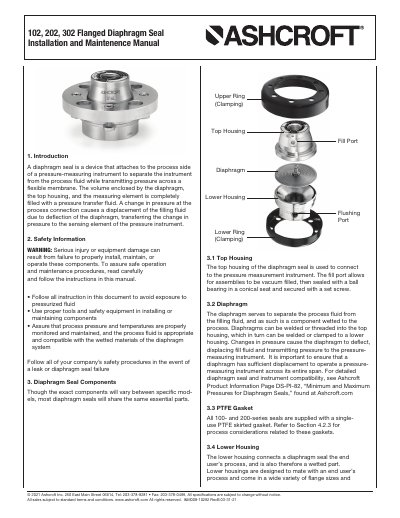
This manual provides step-by-step installation and maintenance instructions for Ashcroft’s 102, 202, and 302 flanged diaphragm seals. It covers safety precautions, component details including diaphragm, housing, and gasket, fill fluid specifications, and installation procedures including flanged connections and flushing ports. Maintenance sections detail storage, inspection frequency, and disassembly guidelines, including warnings about single-use PTFE gaskets and non-disassemblable 300-series seals.
The document also includes temperature and pressure ratings for fill fluids, compatibility notes, and torque specifications for flange connections, ensuring safe and accurate operation in industrial pressure measurement applications.
| Process Connection Sizes | ½, ¾, 1, 1½, 2, or 3 NPS |
|---|---|
| Instrument Connection Sizes | ¼ or ½ NPT female |
| Pressure Ratings | Per ASME flange ratings |
| Wetted Components | Diaphragm, bottom housing, PTFE gasket |
| Fill Fluid Temperature Range | Glycerin: 0°F to 400°F (-18°C to 204°C) |
| PTFE Gasket Temperature Limit | Highest 500°F, lowest -150°F |
Fill fluids include glycerin, silicone, halocarbon, Syltherm® 800, Syltherm® XLT, Calflo® AF, mineral oil, Neobee® M-20, distilled water, and various glycol/water mixtures, each with specific temperature ranges.
Assemblies should be installed and tightened only at the lower housing. Tightening the top housing alters fill fluid dynamics and causes pressure measurement errors.
No, 300-series seals should not be disassembled as the diaphragm is clamped between top and bottom housing; disassembling will result in loss of fill fluid.
Tighten bolts to 30% of target torque in a crisscross pattern, then to 70%, then 100% using the same sequence. After 4 hours, re-tighten to final torque.