
This datasheet details the properties, heat treatments, and specifications of ARMCO PH 13-8 Mo martensitic precipitation hardening stainless steel.
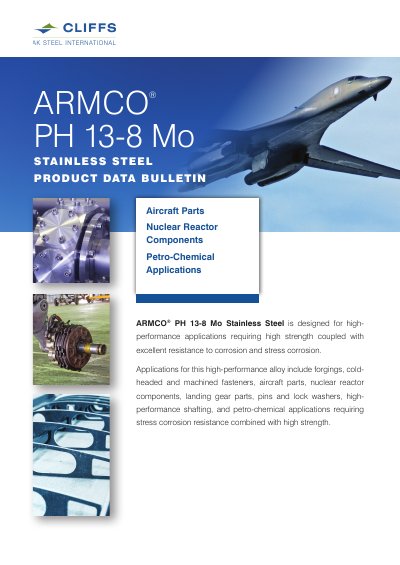
ARMCO PH 13-8 Mo is a martensitic precipitation hardening stainless steel designed for high-performance applications requiring high strength and excellent resistance to corrosion and stress corrosion. It is produced via vacuum induction melting plus consumable electrode vacuum arc remelting (VIM-VAR) to ensure high-quality chemical compositions and optimum solidification conditions. The alloy is suitable for large sections where notch toughness, high strength, and stress corrosion resistance are critical, such as in aerospace, nuclear reactor components, and petro-chemical applications.
The document provides comprehensive data on standard heat treatments, including single low-temperature treatments and multiple-cycle treatments, which determine the final mechanical properties. It details mechanical properties such as tensile strength, yield strength, elongation, and hardness across various conditions (e.g., Condition A, RH 950, H 1000). Additionally, it covers physical properties, magnetic permeability, fabrication methods, and corrosion resistance data.
| Material Type | Martensitic precipitation hardening stainless steel |
|---|---|
| Production Process | Vacuum induction melting plus consumable electrode vacuum arc remelting |
| Chromium Content | 12.25 – 13.25 wt % |
| Nickel Content | 7.50 – 8.50 wt % |
| Molybdenum Content | 2.00 – 2.50 wt % |
| Carbon Content | 0.05 max. |
| UNS Designation | UNS S13800 |
| AMS Specification | AMS 5629 |
| ASTM Specification | ASTM A564 |
| Tensile Strength (Condition H 1000) | 1517 MPa (220 ksi) |
| Yield Strength (Condition H 1000) | 1413 MPa (205 ksi) |
It is produced by vacuum induction melting plus consumable electrode vacuum arc remelting (VIM-VAR).
Applications include aircraft parts, nuclear reactor components, landing gear parts, and petro-chemical applications requiring stress corrosion resistance.
Most users heat treat with a single treatment at 538 °C (1000 °F) or higher for optimum combinations of strength, toughness, and resistance to stress-corrosion cracking.
The maximum carbon content is 0.05 wt %.