
AP Racing guide to bedding in, cooling, temperature monitoring, wear limits and maintenance of carbon/carbon brake discs and pads.
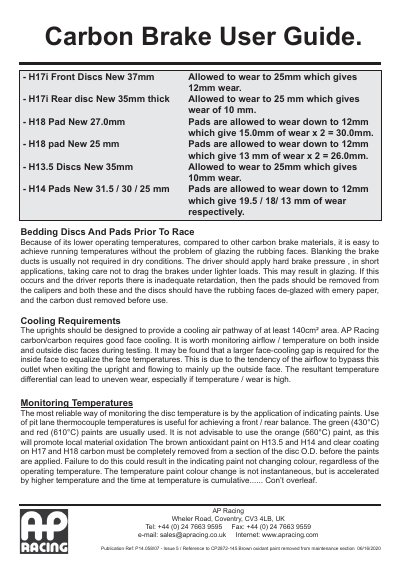
This two-page AP Racing Carbon Brake User Guide (Publication Ref: P14.058/07, Issue 5) explains how to bed in carbon discs and pads before a race, including hard brake pressure in short applications and avoiding dragging the brakes under lighter loads. It also describes de-glazing rubbing faces with emery paper if retardation is inadequate.
The guide covers cooling requirements, such as a cooling air pathway of at least 140cm² in the uprights, and temperature monitoring with indicating paints. It lists wear limits for H17i, H13.5 discs and H18, H14 pads, gives guidance on wear prediction in race trim, and notes maintenance points such as machining uneven surfaces and never degreasing the material with solvents.
| Cooling air pathway area in uprights | at least 140cm² |
|---|---|
| Green indicating paint temperature | 430°C |
| Red indicating paint temperature | 610°C |
| H17i front disc thickness | new 37 mm, wear limit 25 mm (12 mm wear) |
| H17i rear disc thickness | new 35 mm, wear limit 25 mm (10 mm wear) |
| H18 pad thickness (27.0 mm) | new 27.0 mm, wear limit 12 mm |
| H13.5 disc thickness | new 35 mm, wear limit 25 mm (10 mm wear) |
| H14 pad thickness | new 31.5 / 30 / 25 mm, wear limit 12 mm |
| Recommended brake-on temperature, H13/H14 compounds | around 325°C |
| Recommended brake-on temperature, H17I/H18 compounds | 375°C |
| Cleaning by heating | half hour at 300°C |
The driver should apply hard brake pressure in short applications and take care not to drag the brakes under lighter loads, which may cause glazing.
Remove the pads from the calipers and de-glaze both the pads and the discs with emery paper, then remove the carbon dust before use.
Indicating paints are the most reliable method; the green (430°C) and red (610°C) paints are usually used, while the orange (560°C) paint is not advised.
At least 5 consecutive laps at representative speed should be completed before referring to the temperature paint.
No. Do not attempt to degrease the material with any solvents; most contaminants can be evaporated by heating in an oven for half hour at 300°C.