
This design guide provides recommendations for correctly using Aosong CO2 sensors, covering placement, thermal isolation, airflow, sunlight protection, and…
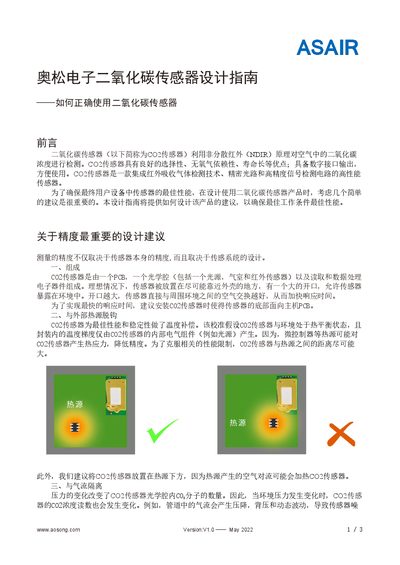
The guide explains how to achieve optimal performance of the CO2 sensor by placing it near the enclosure opening, orienting the sensor bottom toward the host PCB, and keeping it away from heat sources and direct sunlight. It also advises isolating the sensor from airflow disturbances and using proper shielding.
Hardware recommendations include using a dedicated power supply, operating voltage of 4.75‑5.25 V, and selecting either I²C or UART communication (I²C default, UART when Pin 5 is pulled low). Software guidance covers communication speed limits, UART settings (1200 bps), and calibration procedures. This manual is written in Chinese.
| Communication interfaces | I²C and UART |
|---|---|
| Operating voltage range | 4.75 V – 5.25 V |
| Maximum I²C speed | 100 kHz |
| UART baud rate | 1200 bps |
| Pin 5 function | I²C when floating, UART when pulled low |
| Sensor inlet window size | 13.1 mm × 8.1 mm |
| Recommended soldering temperature | ≤ 350 °C, ≤ 3 s |
The sensor should be installed with its bottom side facing the host PCB to achieve the fastest response time.
The sensor should be powered within a voltage range of 4.75 V to 5.25 V.