
Owner's manual for the Ampire KV-Vito reversing camera, covering installation, wiring, technical data, precautions and disposal.
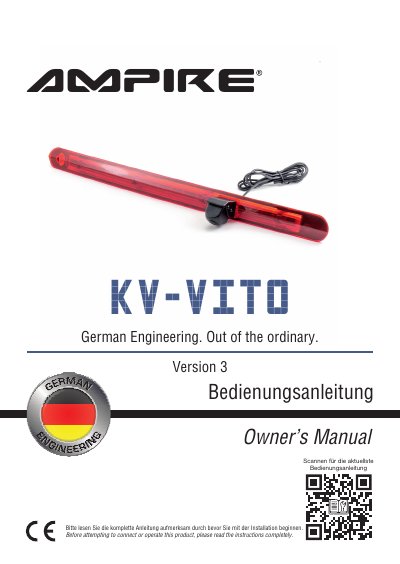
This is the German/English owner's manual (Version 3) for the Ampire KV-Vito reversing camera. It gives precautions for installing the camera in a vehicle, describes the mounting and wiring (yellow video lead, white lead without function, red lead to the reversing signal, black lead to ground) with the supplied 10 m cable, and lists the technical data. It closes with important notices, environmental and disposal instructions and the EU conformity statement.
The manual lists a PC3089 CMOS image sensor with 720 x 480 effective pixels (NTSC) and 600 TV lines, 0.1 lux minimum illumination, a 150° diagonal and 120° vertical viewing angle, protection category IP67 – IP68, 1.0 Vp-p / 75 Ohm video output and DC 9 - 12 V operation at 150 mA max. Ampire states that the camera must not be used for continuous operation or connected to ACC (KL15), and that use is not permitted within the scope of StVZO and ECE; the camera is declared compliant with directives 2014/30/EU, 2014/35/EU and 2011/65/EU. This manual is written in German.
| Image Sensor | PC3089 CMOS |
|---|---|
| Effective Pixels | 720 x 480 (NTSC) |
| Resolution | 600 TV Lines |
| Minimum Illumination | 0,1 Lux |
| Diagonal Viewing Angle | 150° |
| Vertical Viewing Angle | 120° |
| Protection Category | IP67 – IP68 |
| Video Output | 1,0 Vp-p, 75 Ohm |
| Operating Voltage | DC 9 - 12V |
| Current Consumption | 150 mA max. |
| Working Environment | -20° ~ +70° C (Rh 95 %) |
| Cable Length | 10 m |
The camera uses a PC3089 CMOS sensor with 720 x 480 effective pixels (NTSC) and delivers 600 TV lines.
No. The manual states the camera is not suitable for continuous operation or monitoring and must not be connected to ACC (KL15) because it could be damaged by overheating.
It is not allowed within the scope of StVZO and ECE; the shown items are for show purposes and motorsports only.
Clean it with a clean, soft, wet cloth; chemical cleaners or solvents may damage the plastic parts or the lens.