
User manual for Ameritec's AM5 Classic and AM5e Classic wideband transmission test sets, covering operation, measurements, and features.
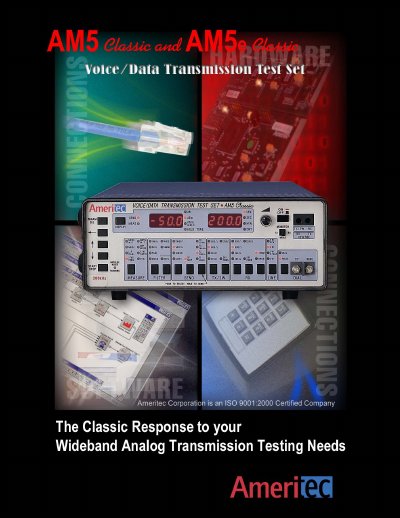
The AM5 Classic and AM5e Classic are portable, easy-to-use test sets for transmission impairment measurements. They support IEEE 743-1984 and CCITT standards, with optional 200 kHz bandwidth. Features include a programmable signal generator, digital controls, and maintenance-free batteries.
The instruments operate in full duplex mode, with separate send/receive terminations and DCHold circuits. They can measure noise, S/N ratio, frequency response, and more, with auto-ranging and LED display. Optional accessories include battery packs, rack mounts, and signaling adapters.
| Operating Bandwidth | 20 Hz to 120 kHz (optionally to 200 kHz) |
|---|---|
| Signal Generator Range | 20 Hz to 120 kHz (optionally to 200 kHz) |
| Signal Level Range | -50 dBm to +13 dBm |
| Standards Compliance | AM5 Classic: IEEE 743-1984; AM5e Classic: CCITT |
The operating bandwidth is 20 Hz to 120 kHz, with an optional 200 kHz bandwidth for qualifying circuits.
AM5 Classic conforms to IEEE 743-1984 standards; AM5e Classic conforms to CCITT recommendations.
Any frequency from 20 Hz to 120 kHz (optionally to 200 kHz) at levels from -50 dBm to +13 dBm.