
This document is the manual for the ET/ER218-2 / ET/ER218-3 receiver and transmitter. It details the functions, usage methods, and precautions of the receiver and transmitter.
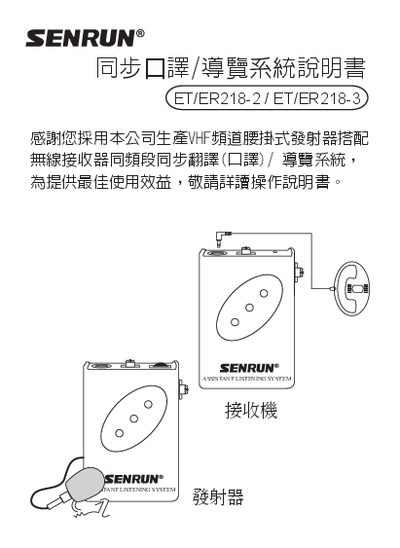
The ET/ER218-2 and ET/ER218-3 are VHF‑band waist‑mounted transmitters paired with a wireless receiver for synchronous interpretation and navigation. The system includes a 3.5 mm microphone input, volume knob, power indicator, and a selectable three‑channel VHF carrier (160‑250 MHz). Battery compartments hold two AAA cells and the device can operate for up to 10 hours.
The manual provides step‑by‑step instructions for turning the unit on/off, selecting channels, adjusting volume, and using optional head‑mounted or lapel microphones. It also lists technical specifications such as output power, sensitivity, frequency stability, and operating distance of up to 60 m. This manual is written in Chinese.
| Carrier frequency range | VHF 160–250 MHz |
|---|---|
| Maximum output power | 10 mW |
| Current consumption | 40 mA ± 10 mA |
| Sensitivity | -90 dBm ± 2 dB |
| Modulation deviation | ±15 kHz |
| Frequency stability | < ±0.005 % |
| Distortion | < 0.5 % at 1 kHz |
| Frequency response | 100 Hz–15 kHz (±3 dB) |
| Battery type | 2 × AAA (UM‑4) |
| Operating time | 8–10 hours |
| Dimensions | 88 × 61 × 22 mm |
| Antenna type | Hidden |
| Maximum range | 60 m |
Use the ON/OFF switch; the red power indicator flashes while turning on and stays solid when the battery is low.
The system provides three selectable VHF channels.
A capacitive microphone is used; you can attach a head‑mounted mic or a lapel mic, and keep the volume knob away from the maximum setting for best performance.
The device can operate for 8 to 10 hours on two AAA batteries.