
The ZRJQ type electric O-ring control ball valve is composed of the 3810R or 3410R series angle stroke electric actuator and the O-ring ball valve. Currently, this valve is widely used in food, environmental protection, light industry, petroleum, papermaking, chemical teaching and scientific research equipment, power and other industries of industrial automatic control systems. Its features are small fluid resistance, rapid and convenient switching, good sealing, long life, high reliability, smooth and smooth valve body channel, more suitable for transporting viscous fluids, slurries and solid particles.
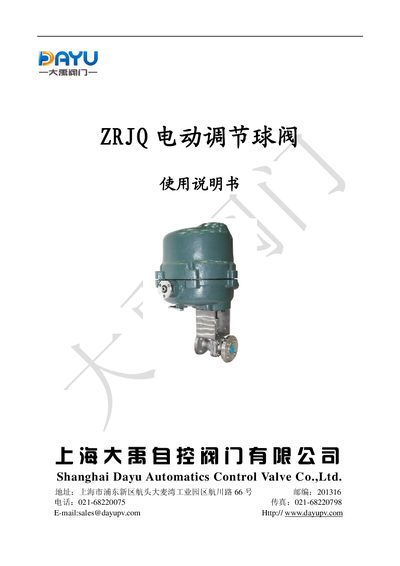
This manual describes the ZRJQ series electric O‑type regulating ball valve, which combines a 3810R or 3410R angular‑travel actuator with an O‑type ball valve. It outlines the valve’s features, model coding, working principle, structure and main technical data, including size ranges, pressure ratings and material options.
Detailed sections cover installation guidelines, safe operation, fault analysis, maintenance procedures, transportation, storage, unpacking, and ordering information. The document also provides wiring and signal requirements for the actuator and a comprehensive troubleshooting table for common fault conditions. This manual is written in Chinese.
| Nominal size | 15‑300 mm |
|---|---|
| Nominal pressure | PN1.6, 4.0, 6.4, 31.5 MPa (custom) |
| Connection type | Flanged (法兰式) |
| Body material | HT200, ZG25I, ZG1Cr18Ni9, WCB, ZG0Cr17Ni12Mo2 |
| Operating temperature | -20 °C ~ +120 °C (normal) / +120 °C ~ +450 °C (heat‑dissipating) |
| Flow coefficient (Kv) at 50 mm, 10° | 2 |
The actuator is powered by a 220 V AC single‑phase supply.
The normal‑temperature version operates from –20 °C to +120 °C, while the heat‑dissipating version operates from +120 °C to +450 °C.