
PCR Kit with Taq is a PCR kit that includes Taq DNA Polymerase, PCR buffer, dNTP and loading buffer, and can be used for PCR reaction with self-prepared template and primer, suitable for ordinary PCR or RT-PCR qualitative or quantitative detection, and can also be used for cloning of not too long DNA fragments.
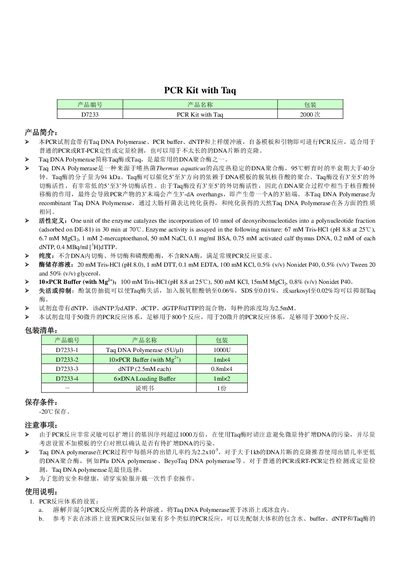
This manual describes the contents of the D7233 PCR Kit, which includes Taq DNA polymerase, 10x PCR buffer, dNTP mix, loading buffer and a usage guide. It provides product details, storage conditions, and safety precautions for reliable PCR or RT‑PCR applications.
The document also explains how to set up PCR reaction mixtures, program thermal cycler parameters, and troubleshoot common issues such as low yield, non‑specific bands, and high GC templates. A FAQ section addresses typical problems and offers practical solutions. This manual is written in Chinese.
| Enzyme molecular weight | 94 kDa |
|---|---|
| Enzyme half‑life at 95 °C | >40 min |
| Storage temperature | -20 °C |
| Reactions per kit (50 µL) | 800 reactions |
The most common cause is poor primer design; check primer length, GC content, secondary structure, and avoid primer‑dimer formation.
Use a GC‑rich buffer and adjust the annealing temperature or add additives such as DMSO to facilitate denaturation of GC‑rich regions.
Set the cycle number to about 33 cycles for initial tests, then optimize based on product yield and specificity.
Prepare the mixture on ice, keep the tubes on ice during setup, and avoid adding the enzyme at room temperature.