
Product leaflet for the 3M Detcon FP-524D combustible gas sensor, featuring matched-pair catalytic bead technology and MicroSafe intelligent electronics for…
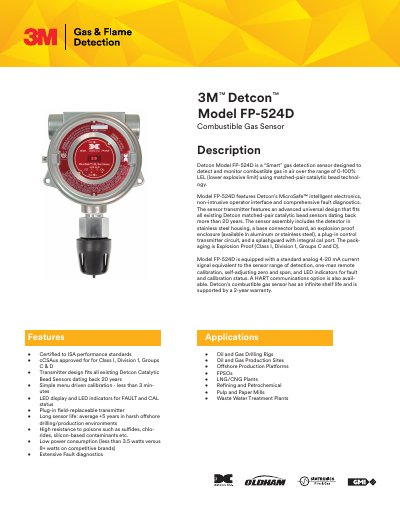
The 3M Detcon Model FP-524D is a smart gas detection sensor designed to detect and monitor combustible gases in air over a range of 0-100% LEL. It utilizes matched-pair catalytic bead technology and features Detcon's MicroSafe intelligent electronics, a non-intrusive operator interface, and comprehensive fault diagnostics. The sensor assembly includes a stainless steel detector housing, a base connector board, an explosion-proof enclosure available in aluminum or stainless steel, a plug-in control transmitter circuit, and a splashguard with an integral calibration port.
| Measurement Range | 0-100% LEL |
|---|---|
| Accuracy/Repeatability | ±3% 0-50% LEL ±5% 50-100% LEL |
| Response Time T50 | <10 seconds |
| Response Time T90 | <30 seconds |
| Power Input | 12-28 VDC |
| Power Consumption (Normal) | 68mA (<1.7 watt) |
| Operating Temperature (USA) | -25°C to +40°C |
| Operating Humidity | 5-100% RH non-condensing |
| Warranty | 2 year warranty |
It uses matched-pair catalytic bead technology.
The sensor detects combustible gas over the range of 0-100% LEL.
Yes, the transmitter design fits all existing Detcon matched-pair catalytic bead sensors dating back more than 20 years.
The typical sensor life is 3 to 5 years.