
The FIZOPTIKA VG910 Fiber Optic Rotation Sensor specification manual provides physical parameters, connection diagram, output details, and handling…
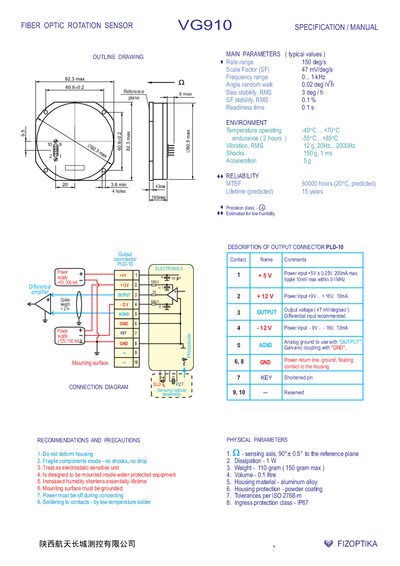
This manual describes the VG910 fiber optic rotation sensor, including its physical dimensions, housing material, and protection class. It also gives recommended installation precautions such as avoiding shocks, grounding the mounting surface, and treating the unit as electro‑static sensitive.
Key performance data are listed, covering sensing axis tolerance, power consumption, output voltage, frequency range, temperature limits, and reliability figures like MTBF and predicted lifetime. Connection diagrams and output connector pin assignments are also provided.
| Sensing axis tolerance | 90 °± 0.5° to the reference plane |
|---|---|
| Power dissipation | 1 W |
| Weight | 1‑10 g (150 g max) |
| Volume | 0.1 litre |
| Housing material | Aluminum alloy |
| Ingress protection class | IP67 |
| Power input (+5 V) | ±0.25 V, 200 mA max |
| Power input (+9 V … +16 V) | 10 mA |
| Output voltage | 47 mV/deg/sec |
| Operating temperature range | -40 °C … +70 °C |
| MTBF | 60 000 h (20 °C predicted) |
| Predicted lifetime | 15 years |
The sensor can be powered with +5 V (±0.25 V, up to 200 mA) or with +9 V to +16 V at up to 10 mA.
The output voltage is 47 mV for each degree per second of rotation.
It has an ingress protection rating of IP67.
The sensor operates from –40 °C to +70 °C (endurance –55 °C to +85 °C).