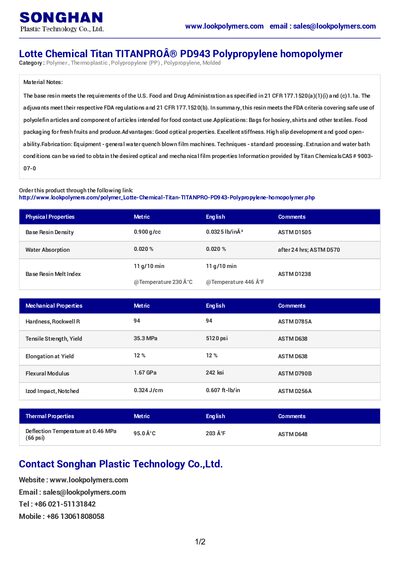
Technical data sheet for Lotte Chemical TITANPRO® PD943 polypropylene homopolymer, including properties, FDA compliance, and applications.
About this manual
The TITANPRO® PD943 polypropylene homopolymer from Lotte Chemical meets U.S. FDA requirements for food‑contact use (21 CFR 177.1520). It is designed for applications such as hosiery, shirt bags, and fresh‑produce packaging, offering good optical properties, high stiffness, and slip development.
Physical, mechanical, and thermal properties are listed, including density, melt index, hardness, tensile strength, elongation, flexural modulus, impact resistance, and deflection temperature. The material can be processed on standard water‑quench blown‑film equipment using typical processing techniques.
What's inside
- Category
- Notes
- Applications
- Advantages
- Fabrication
- Physical Properties
- Mechanical Properties
- Thermal Properties
- Contact
Specifications
| Density | 0.900 g/cc |
|---|
| Melt Index | 11 g/10 min @ 230 °C |
|---|
| Hardness (Rockwell R) | 94 |
|---|
| Tensile Strength, Yield | 35.3 MPa |
|---|
| Elongation at Yield | 12 % |
|---|
| Flexural Modulus | 1.67 GPa |
|---|
| Izod Impact (Notched) | 0.324 J/cm |
|---|
| Deflection Temperature at 0.46 MPa | 95 °C |
|---|
Frequently asked questions
What FDA regulations does TITANPRO® PD943 comply with?
The resin meets the U.S. FDA requirements specified in 21 CFR 177.1520(a)(1)(i) and (c), and its adjuvants meet the corresponding FDA regulations.
What are the typical applications for TITANPRO® PD943?
It is used for bags for hosiery, shirts and other textiles, as well as food packaging for fresh fruits and produce.
How can TITANPRO® PD943 be processed?
The material can be fabricated using general water‑quench blown‑film machines with standard processing techniques.