
Safety Data Sheet for Hollowick butane lighter, detailing hazards, handling, storage, and regulatory information.
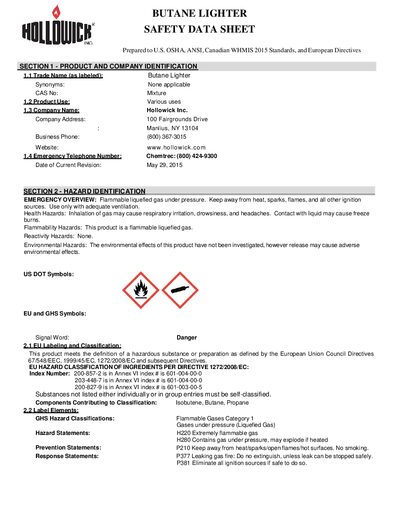
This Safety Data Sheet (SDS) provides comprehensive information about the Hollowick butane lighter, including product identification, composition, and the hazards associated with its use. It is prepared to meet U.S. OSHA, ANSI, Canadian WHMIS 2015 standards, and European directives.
The document covers sections such as Hazard Identification, First‑Aid Measures, Fire‑Fighting Measures, Accidental Release, Handling and Storage, Exposure Controls, Physical and Chemical Properties, Stability, Toxicology, Ecological Impact, Disposal, Transportation, and Regulatory information, helping users safely handle and comply with legal requirements.
| Isobutane content | 50‑70 % |
|---|---|
| Butane content | 20‑50 % |
| Propane content | 5‑20 % |
| Physical state | Clear liquid (gaseous under pressure) |
| Flammability | Extremely flammable gas |
It is a flammable liquefied gas under pressure; keep away from heat, sparks, flames, and all other ignition sources.
Use water spray, carbon dioxide, foam, dry chemical, or halon; do not extinguish until the leak is addressed or the source is shut off.
The occupational exposure limit for isobutane is a TWA of 800 ppm (1,900 mg/m³).