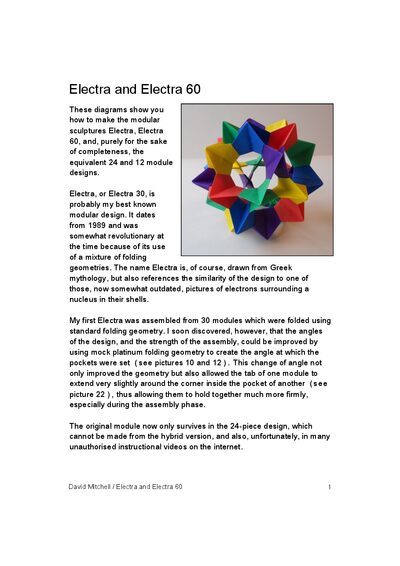
Step‑by‑step folding and assembly instructions for the Electra modular paper sculptures (Electra, 60, 24, 12).
About this manual
This manual provides detailed folding diagrams and assembly steps for creating the modular paper sculptures designed by David Mitchell. It covers the original Electra (30 modules), the larger Electra 60, as well as the 24‑module and 12‑module variants, including colour‑scheme suggestions.
Each section explains how to fold individual modules, create pockets and tabs, and combine them into the geometric polyhedral structures (icosidodecahedron, rhombicosidodecahedron, rhombicuboctahedron). The instructions also describe optional three‑armed versions and tips for using patterned paper.
What's inside
- Folding Steps
- Assembly Instructions
- Module Variants
- Colour Scheme
- Underlying Geometry
Specifications
| Modules required for Electra | 30 squares of paper |
|---|
| Modules required for Electra 60 | 60 squares of paper |
|---|
| Modules required for Electra 24 | 24 squares of paper |
|---|
| Modules required for Electra 12 | 12 squares of paper |
|---|
| Underlying structure of Electra | Icosa‑dodecahedron |
|---|
| Underlying structure of Electra 60 | Rhombicosidodecahedron |
|---|
| Underlying structure of Electra 24 | Rhombicuboctahedron |
|---|
Frequently asked questions
How many paper squares are needed to make the original Electra sculpture?
You need thirty squares of paper to fold the thirty modules required for Electra.
What geometric shape does the completed Electra 60 form?
The completed Electra 60 forms a rhombicosidodecahedron.
Can the Electra module be modified to a three‑armed version?
Yes, by hiding one arm inside the module you can create a three‑armed version that assembles into different polyhedra.
What colour scheme is recommended for the modules?
The instructions suggest using five contrasting but complementary colours, with each colour repeated across the set of modules.