
This document describes how to build an application using the IBM Redbooks Solution Guide.
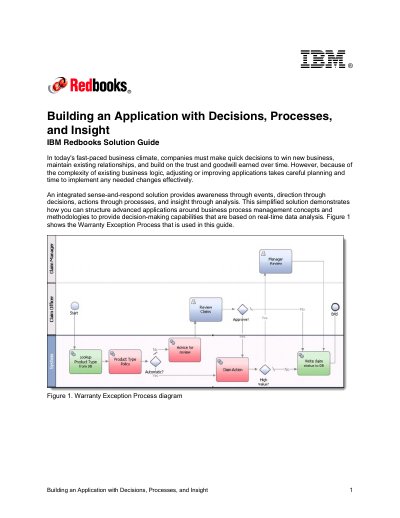
This IBM Redbooks solution guide explains how to structure advanced applications around business process management concepts and methodologies. It uses a warranty exception process and a warranty reporting solution as examples to show how events, decisions, processes, and analysis are integrated.
The guide lists IBM products used in the solution, including IBM Business Process Manager, IBM WebSphere Operational Decision Management, IBM Cognos Business Intelligence, IBM InfoSphere Data Architect, and IBM Solution for Collaborative Lifecycle Management. It also describes software development roles and product-specific roles associated with the solution.
The guide describes BPM as the discipline for managing interactions between systems and humans.
It accepts post-purchase claims for product repair or replacement from a customer and processes all claims by using an online reporting tool.
The guide lists IBM Business Process Manager, IBM WebSphere Operational Decision Management, IBM Cognos Business Intelligence, IBM InfoSphere Data Architect, and IBM Solution for Collaborative Lifecycle Management.
The roles include analyst, data developer, business developer, test engineer, and project leader.