
Wyoming Aquatic Invasive Species Watercraft Inspection and Decontamination Manual
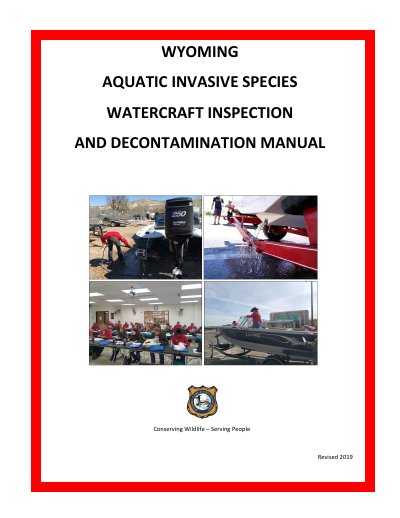
This manual outlines standard watercraft inspection and decontamination procedures for authorized AIS inspectors in Wyoming. It covers inspection priorities, equipment, station locations, standard and high-risk inspection protocols, watercraft seals and receipts, and decontamination procedures for standing water, live-wells, bilges, ballast tanks, engines, jet skis, jet boats, and plants.
The document also addresses suspected AIS findings, quarantine times for mussel-encrusted watercraft, other aquatic invasive species of concern, and appendices covering different watercraft types, high-risk states and waters, location codes, glossary terms, department contacts, certification guidelines, statutes, regulations, and AIS decals.
| Document revision | Revised March 2019 |
|---|---|
| Zebra and quagga mussel adult length | Up to two inches long |
| Mussel survival temperature range | 33° F to 86°F (1° to 30°C) |
| Zebra mussel reproduction temperature | Above 54°F (12°C) |
| Quagga mussel reproduction temperature | As cold as 48°F (9°C) |
| Veliger drift period | About four to eight weeks |
| Zebra mussel discovery in the Great Lakes | 1988 |
| Quagga mussel first found in the Great Lakes | 1989 |
It outlines standard watercraft inspection and decontamination procedures to be followed by authorized AIS inspectors to prevent the spread of AIS into and within Wyoming.
The procedures apply to watercraft of any and all kinds, including motors, trailers, compartments, and other associated equipment or containers that could contain or have contacted water.
The manual emphasizes zebra and quagga mussels, while stating that the procedures apply to all aquatic invasive species.
They can hitch rides on boats, trailers, and equipment, and boaters and anglers can inadvertently transport them on waders and in bait buckets and live-wells.