
Origin, economic importance and geographical distribution of asparagus.
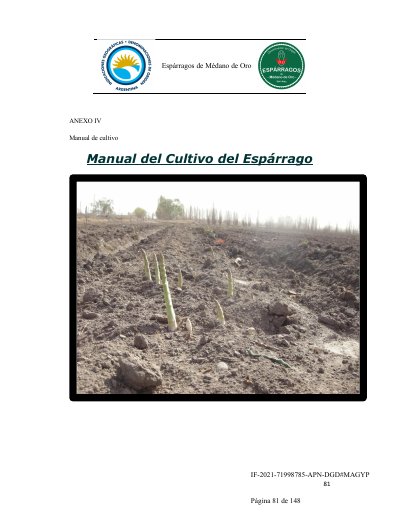
Manual del Cultivo del Espárrago is a Spanish-language cultivation guide. It covers the origin and economic importance of asparagus, taxonomy and morphology, climate, light and soil requirements, plant material, genetic improvement, and cultivation practices such as land preparation, transplanting, direct sowing, weed control, planting density, cutting, fertilization, and irrigation.
The text also lists asparagus varieties suited to San Juan, describes male and female plants, and gives production data for major producing countries. It notes soil pH values, temperature and humidity ranges, and wind-protection measures for crops in Médano de Oro, Rawson, San Juan, Argentina. This manual is written in Spanish.
| Plant height at full development | 1.50 m |
|---|---|
| Turion growth temperature | 11-13°C monthly average |
| Optimal vegetative development temperature | 18-25°C |
| Optimal relative humidity during turion growth | 60-70% |
| Soil pH | 6.95-7.74 |
| Groundwater table depth | at least 5-8 m |
The manual gives the botanical name as Asparagus officinalis var. altilis L.
The manual lists China, Peru, the United States, Spain, Mexico, Germany, Italy, Morocco, Greece, Japan, France, Chile, Australia, the Netherlands, Bulgaria, the Philippines, Argentina, South Africa, Hungary, Colombia, and Canada with 2001 and 2002 production figures.
The reported soil pH values range from 6.95 to 7.74.
The manual mentions F1 and F2 UC-157, UC 115, Early California, Mary Washington, and Criollo.