
This document summarizes the latest research on salmon farming. Researchers have found that improving the quality of salmon feed and improving the health of salmon can improve the resistance of salmon to disease.
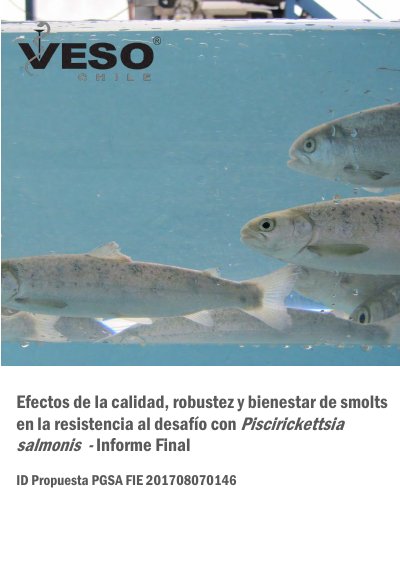
This final report describes a project on Atlantic salmon smolts in Chile. It examines how smolt quality, robustness and welfare relate to resistance to Piscirickettsia salmonis, the bacterium that causes piscirickettsiosis (SRS). The report covers theoretical background, objectives, system setup, exercise and challenge activities, results, conclusions and cost-benefit analysis.
The study compared an exercised group with a control group during freshwater culture. The exercised group showed 4% greater weight gain and better fin condition, with differential expression of 522 cardiac genes. In a 62-day cohabitation challenge with P. salmonis, cumulative mortality reached 73% and no statistically significant survival difference was found between groups. This manual is written in Spanish.
It studies resistance to piscirickettsiosis (SRS), caused by Piscirickettsia salmonis.
In Atlantic salmon, SRS accounts for 67.9% of infectious-disease mortality, and 92.9% in rainbow trout.
No statistically significant survival difference was found between the exercised and control groups.
The cohabitation challenge lasted 62 days.