
Manual Drilling Technology in Niger, Guinea and Ethiopia

The use of manual drilling technology in Guinea, Niger and Ethiopia
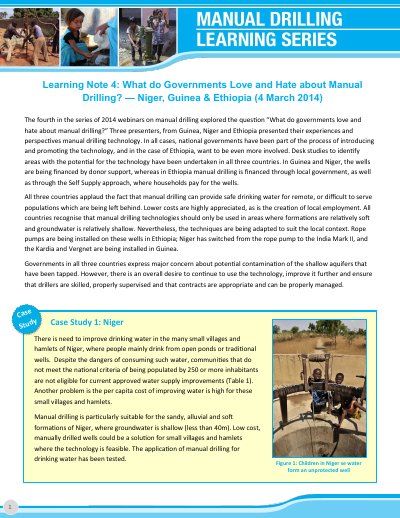

Manual Drilling Technology in Niger, Guinea and Ethiopia - cover page
Brand
Unicef
Category
Other products
Document type
Other
Language
English
Pages
7
File format
PDF
File size
1.3 MB
Published
19 November, 2023
Updated
19 November, 2023
MD5 checksum
DBC524EE8B729CAF5E953760C4E513CF

About this manual

This document serves as a learning note from a 2014 webinar series, examining the experiences and perspectives of national governments in Niger, Guinea, and Ethiopia regarding manual drilling technology. It highlights that while all three countries recognize the benefits of providing safe drinking water to remote populations at lower costs, they express concerns about potential contamination of shallow aquifers. The text details how each country has adapted the technology to suit local geological and institutional contexts.

What's inside

  • What do Governments Love and Hate
  • Case Study 1: Niger
  • Case Study 2: Guinea
  • Case Study 3: Ethiopia
  • Self Supply approach
  • Types of pumps
  • Drilling costs
  • Water quality testing
  • Technical standards
  • Future needs

Frequently asked questions

What is the maximum depth for manual drilling in Niger?

In Niger, manual drilling is suitable for areas where groundwater is shallow, specifically less than 40 meters deep.

What is the estimated cost to install a manually drilled well in Niger with a rope pump?

The cost for a 25-meter depth well installed with a rope pump is approximately US$1,700.

What drilling techniques are used for manual drilling in Guinea?

The drilling methods used in Guinea include jetting and rota sludge techniques.

Download PDF (1.3 MB)

More Unicef Manuals


View all Unicef manuals →