
Guide to Flammable and Combustible Liquids under the WHS Act 2011

This document is a guide to flammable and combustible liquids. It introduces the provisions of the Work Health and Safety Act 2011 on flammable and combustible liquids.
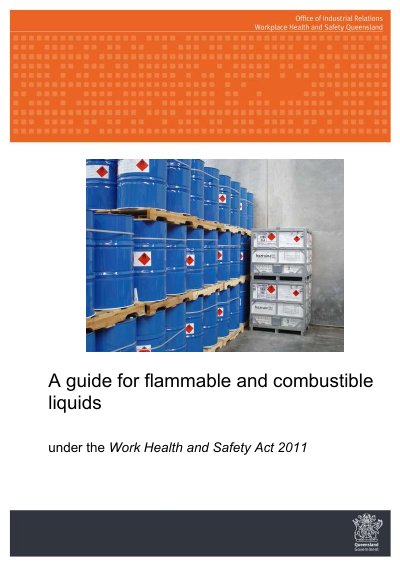

Guide to Flammable and Combustible Liquids under the WHS Act 2011 - cover page
Category
Other
Document type
Other
Language
English
Pages
18
File format
PDF
File size
606 KB
Published
19 November, 2023
Updated
19 November, 2023
MD5 checksum
9E30820858AF61C13B1DFD08FA77AFF8

About this manual

This document serves as a guide for the Queensland Work Health and Safety Act 2011 (WHS Act) regarding the storage, handling, and use of hazardous chemicals, specifically flammable and combustible liquids (FCL). It outlines the duties of a Person Conducting a Business or Undertaking (PCBU) and details the relationship between the WHS Regulation, the Globally Harmonised System (GHS), the Australian Dangerous Goods Code (ADG Code), and Australian Standard AS1940.

What's inside

  • Introduction
  • Work Health and Safety Regulation 2011
  • Abolition of licensing
  • Classification of flammable and combustible liquids
  • GHS classification under the WHS Regulation
  • Australian Dangerous Goods Code classification
  • AS1940 definitions for combustible liquids
  • Storage solutions under AS1940
  • Fire protection and warning signs
  • Notifications

Frequently asked questions

What is the flash point range for a liquid to be classified as a flammable liquid under the WHS Regulation?

A liquid is classified as a flammable liquid if it has a flash point of not more than 93°C.

What is the flash point range for a liquid to be classified as Class C1 combustible liquid under AS1940?

Class C1 combustible liquids have a closed cup flashpoint of greater than 60°C and no greater than 93°C.

Download PDF (606 KB)

Also Manuals