
The Ele-fence is a low-cost solar-powered fence that can be used to manage human-elephant conflict. It consists of a power unit, an earthing system, a warning sign, and a single-strand wire. To install the fence, you will need to select a suitable site, install the fence posts and insulators, and then connect the wire to the power unit.
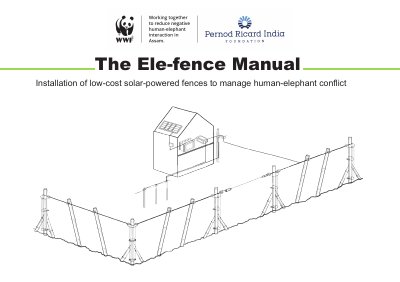
This manual provides step-by-step instructions for installing and maintaining low-cost, single-strand, solar-powered fences designed to protect human life, property, and crops from wild elephants. The Ele-fence is a non-lethal system that delivers a shock only when an elephant completes a circuit by touching the wire and the ground. It is intended for officials, conservation NGOs, and communities to safely deploy in areas with moist soil and limited budgets.
| Solar panel power | 80-100 Watts |
|---|---|
| Solar charge controller | 10 amps |
| Battery voltage | 12 V |
| Battery capacity | 100-120Ah |
| Energizer pulse duration | 0.003 seconds |
| Energizer pulse gap | 1.2 seconds |
| Operating voltage range | 6000 and 9000 volts |
No, connecting a fence directly to an AC power source, inverter, or DC to AC converter can result in a lethal shock.
A working fence should have a voltage between 6000 and 9000 V (or 6-9 kV).
Earthing is considered good if the voltage drops below 300 V (0.3 kV) when metal rods are placed on the fence.