
There are four planets worth trying in June, but not the common Venus, Mars, Jupiter and Saturn, but Mercury, Uranus, Neptune and Pluto.
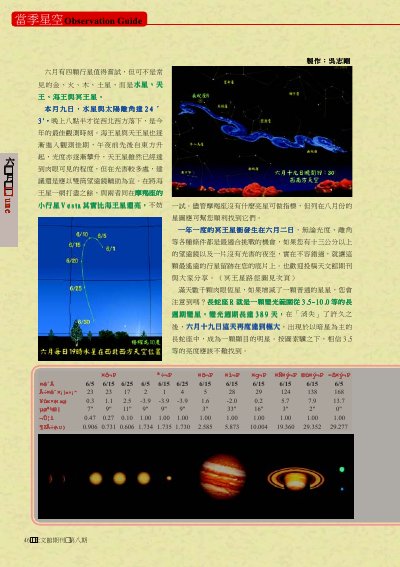
This issue of the Astronomy Journal focuses on celestial events for June and July. It highlights the observation of Mercury, Neptune, Uranus, and Pluto, noting that Pluto offers the best challenge opportunity on June 2nd. The guide also details the appearance of the long-period variable star R Hydrae and the bright comet C/1999 S4. This manual is written in Chinese.
The best opportunity to observe Pluto is on June 2nd, when its magnitude, elongation, and other conditions are most favorable.
The total lunar eclipse occurs on July 16th, starting at 19:57 and ending at 23:54, with the maximum eclipse at 21:55.
The maximum magnitude of the eclipse is 1.773.