
Infants With Spina Bifida: Immediate Responses to Contextual and Manual Sensory Augmentation During Treadmill Stepping

This study examined the effect of combined sensory enhancements and manual assistance on the immediate motor responsiveness of infants with spina bifida during treadmill trials.
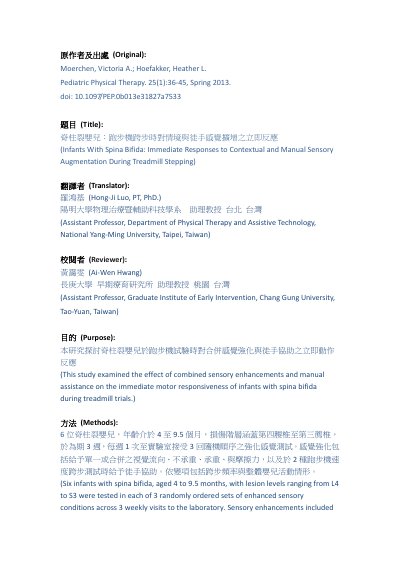

Infants With Spina Bifida: Immediate Responses to Contextual and Manual Sensory Augmentation During Treadmill Stepping - cover page
Category
Other
Document type
Other
Language
ZH-TW
Pages
2
File format
PDF
File size
174 KB
Published
18 November, 2023
Updated
18 November, 2023
MD5 checksum
D8C24E9DD7C756CC47AF09B7C4929701

About this manual

The document presents a study examining the effects of combined sensory enhancements and manual assistance on the immediate motor responsiveness of infants with spina bifida during treadmill trials. The study involved six infants aged 4 to 9.5 months with lesion levels ranging from L4 to S3. This manual is written in Chinese.

What's inside

  • Purpose
  • Methods
  • Results
  • Conclusions
  • Sensory Enhancements
  • Manual Assistance
  • Treadmill Stepping
  • Infants with Spina Bifida

Frequently asked questions

How many infants were included in the study?

Six infants with spina bifida were included.

What age range did the infants have?

The infants were aged 4 to 9.5 months.

Which sensory enhancement was most salient?

Friction combined with load was the most salient contextual sensory enhancement.

What increased infant stepping?

Manual assistance at the slower speed was effective at increasing infant stepping.

Download PDF (174 KB)

Also Manuals