
This document describes the Terco High Voltage Laboratory, which is primarily used for high voltage experiments.
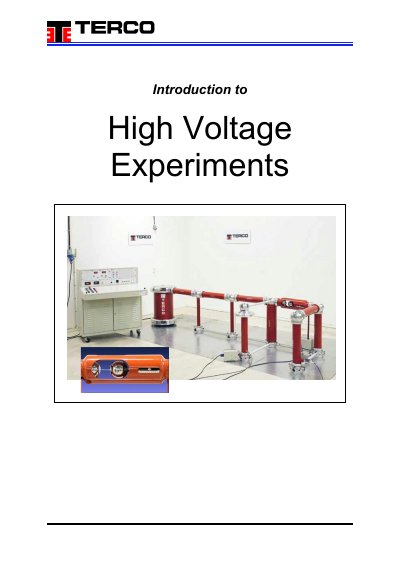
Terco High Voltage Laboratory Introduction to High Voltage Experiments is an orientation aid for carrying out high voltage experiments with the Terco High Voltage Laboratory. It is intended as a companion and preparatory manual to the Terco High Voltage Experiments manual and is aimed at beginners and those unfamiliar with the laboratory components, controls, or routines.
The manual first covers safety regulations for high voltage experiments, including fencing, safety locking, earthing, circuit setup, and accident procedures. It then presents experiments on generation and measurement of AC voltage, DC voltage, and impulse voltage, with Experiment 1 using equipment such as the HV9105 test transformer, HV9103 control desk, HV9141 measuring capacitor, and HV9150 AC peak voltmeter.
| High voltage threshold | greater than 250 V to earth potential |
|---|---|
| Fence clearance, alternating and direct voltages | 50 cm for every 100 kV |
| Fence clearance, impulse voltages | 20 cm for every 100 kV |
| Minimum fence clearance | 50 cm |
| Earth conductor minimum cross-section | at least 1.5 mn2 Cu |
Any voltage greater than 250 V to earth potential is understood to be a high voltage.
Participants must first ensure that all conductors which can assume high potential in the contact zone are earthed and that all main leads are interrupted.
A minimum clearance of 50 cm shall always be observed, independent of the value and type of voltage.
Experiment 1 uses the HV9105 test transformer, HV9103 control desk, HV9141 measuring capacitor, HV9150 AC peak voltmeter, and related connecting and earthing components.