
The article presents the design and development of a low-cost digital hearing aid. The hearing aid uses a generic electronic circuit design and has electroacoustic features that are not inferior to those of hearing aids currently marketed in the Brazilian market. The article also presents the results of performance tests of the hearing aid, which show that the hearing aid is able to meet the needs of hearing-impaired patients.
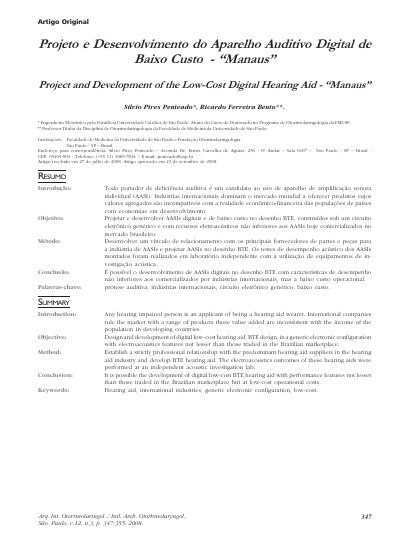
The document describes a research project titled "Manaus" aimed at designing and developing digital hearing aids (AASI) with a behind-the-ear (BTE) design at a low operational cost. The authors argue that international companies dominate the market with products whose value-added costs are incompatible with the economic reality of developing countries. The objective was to create a device using a generic electronic configuration that offers electroacoustic resources not inferior to those currently traded in the Brazilian marketplace. This manual is written in Portuguese.
It is intended to serve hearing losses classified as moderate-severe, from 56 to 70 dB.
It uses a BTE (behind-the-ear) design.
25 prototypes of digital low-cost hearing aids were developed.
They were performed at an independent acoustic investigation lab.