
Manual for Forest Producers: How to Measure the Volume of Wood and Estimate Its Value

This document describes how to measure the volume of wood and estimate its value.
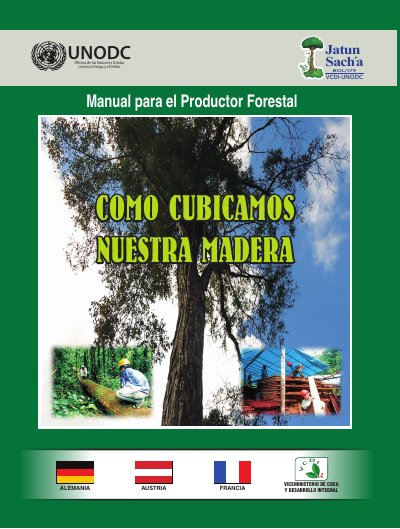

Manual for Forest Producers: How to Measure the Volume of Wood and Estimate Its Value - cover page
Document type
Other
Language
Spanish
Pages
22
File format
PDF
File size
4.5 MB
Published
17 November, 2023
Updated
17 November, 2023
MD5 checksum
B33462397C696D8E8C84641CE0E50232

About this manual

This manual is aimed at producers who want to calculate the wood volumes on their property and estimate the economic value that forest plants can generate. It explains cubicación, the procedure of taking real measurements of standing trees, felled logs, and sawn timber using a flexometer or metric tape.

It covers measurement units, field instruments, volume calculation methods, the standing-tree formula using diameter at breast height and commercial height, and a list of commercially valuable forest species in the municipality of La Asunta. This manual is written in Spanish.

What's inside

  • Presentación
  • Introducción
  • Unidades de medidas
  • Medidas lineales
  • Medidas de área
  • Medidas de volumen
  • Instrumentos utilizados en la cubicación de madera
  • Formas de medir el volumen de árboles en pie tumbados y sus derivados
  • Cubicación árbol en pie
  • Especies forestales de valor comercial en el municipio de la asunta

Frequently asked questions

What is cubicación?

It is a procedure in which the farmer takes real measurements of tree or timber dimensions using a measuring instrument.

Which instruments are used to measure wood in the field?

A flexometer or metric tape.

How is the volume of a standing tree calculated?

Using V = 3.1415 x (Dap)^2 x Hc x f / 4, with a form factor of 0.75.

What measurement systems are used?

The metric system and the English system.

Download PDF (4.5 MB)

Also Manuals