
Objective: To investigate the use of antiepileptic drugs beyond the instructions in children and analyze the reasons, so as to provide a reference for the rational use of antiepileptic drugs in children. Methods: The outpatient prescriptions for antiepileptic drugs from September 2012 to August 2013 were stratified and randomly selected. According to the contents of the drug instructions, it was judged whether there was any use of antiepileptic drugs beyond the instructions. The types of use beyond the instructions were statistically analyzed and the incidence of use beyond the instructions was calculated. Results: Among the 2 400 prescriptions, there were 955 prescriptions for drugs beyond the instructions, accounting for 39. 79% of all prescriptions, mainly for off-label and over-age use. The proportion of antiepileptic drugs used beyond the instructions was as follows: zonisamide tablets (100%), levetiracetam tablets (95. 19%), lamotrigine tablets (48. 08%), sodium valproate tablets (43. 33%), etc. Conclusion: The incidence of antiepileptic drugs used beyond the instructions in children with epilepsy is high, especially zonisamide and levetiracetam. Most of the off-label use has evidence-based medical basis, and it is not the doctor's blind medication. The particularity of medication in children is also an important reason for the use of drugs beyond the instructions. The use of drugs beyond the instructions should be standardized as much as possible to promote rational clinical medication.
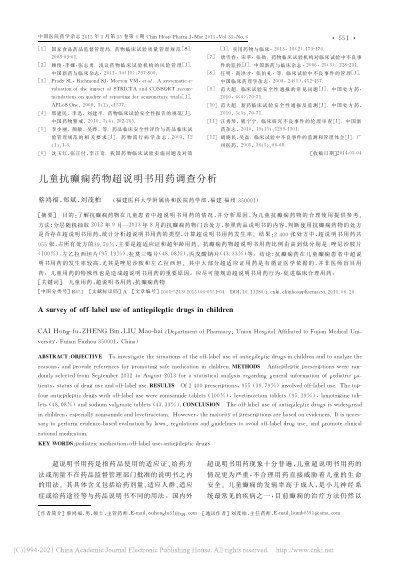
This document is an academic research article titled "A Survey of Off-label Use of Antiepileptic Drugs in Children," published in the Chinese Journal of Hospital Pharmacy in 2015. The study analyzes prescription data collected between September 2012 and August 2013 from the Department of Pharmacy at the Union Hospital Affiliated to Fujian Medical University.
The research focuses on identifying instances where antiepileptic drugs were used in children in ways not approved by the drug regulatory authorities, such as off-label indications, incorrect dosages, or inappropriate age groups. The study categorized these off-label uses into types including off-indication, off-age, off-dose, off-frequency, and off-route. Results indicated that nearly 40% of the 2,400 prescriptions reviewed involved off-label use, with Zonisamide and Levetiracetam showing the highest rates. The authors conclude that while much of this off-label use is based on evidence, stricter regulation and evidence-based evaluation are necessary to promote safe and rational medication practices for children. This manual is written in Chinese.
Off-label use refers to usage where the indication, dosage, or administration method is not within the scope of the drug supervision department's approved instructions.
Out of 2,400 prescriptions analyzed, 955 involved off-label use, accounting for 39.79% of all prescriptions.