
This guide aims to enhance public safety in the use of amusement rides.
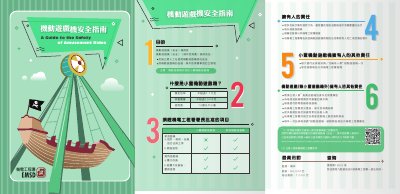
This leaflet from the Electrical and Mechanical Services Department (EMSD) explains the Amusement Rides (Safety) Ordinance and the Amusement Rides (Safety) (Operation and Maintenance) Regulation. It defines a kiddie ride as one with a power rating not more than 1.1 kW, a carrying capacity not more than 100 kg, and users who are children under 12.
It sets out the duties of all ride owners, additional duties for kiddie ride owners and for other amusement ride owners, approvals required from EMSD, and the maximum penalties for offences. This manual is written in Chinese.
A kiddie ride has a power rating not more than 1.1 kW, a carrying capacity not more than 100 kg, and is used by children under 12.
Owners must provide and display notices on prohibited conduct, passenger numbers and permitted weight, inspect the ride daily, keep a log book for EMSD inspection, and report any accident involving death or injury to EMSD.
A kiddie ride owner must arrange a surveyor or qualified person to examine the ride once every six months and keep the examination report for EMSD inspection.
The maximum penalties are imprisonment for 2 years, a fine of $50,000, and a daily penalty of $1,000.