
The Inspector+ is a health and safety instrument that is optimized to detect low levels of radiation. It measures alpha, beta, gamma, and x-rays.
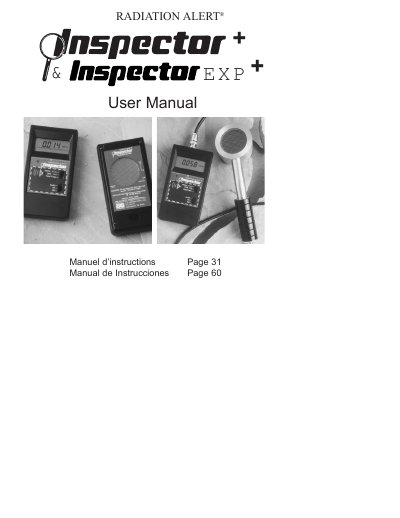
The Inspector+ is a health and safety instrument that detects low levels of alpha, beta, gamma, and x-ray radiation using a two-inch Geiger-Mueller (pancake) tube. It is designed to detect small changes in radiation levels and has high sensitivity to many common radionuclides.
The manual covers unit selection (conventional or SI), dose rate and total/timer modes, timed counts, alert settings, the utility menu, electronic calibration, wiping test procedures, and interfacing to external devices. Appendices provide technical specifications, sensitivity to common isotopes, and warranty information.
| Detected radiation types | Alpha, beta, gamma, and x-ray |
|---|---|
| Detector type | Two-inch Geiger-Mueller (pancake) tube |
| mR/hr range | 0.001 to 100 mR/hr |
| µSv/hr range | 0.01 to 1000 µSv/hr |
| CPM range | 0 to 300,000 counts per minute |
| CPS range | 0 to 5000 counts per second |
| Total/Timer range | 1 to 9,999,000 accumulated counts |
| Power supply | Standard 9-volt alkaline battery |
| Maximum operating temperature | Do not exceed 100 °F (38 °C) |
It uses a Geiger-Mueller tube that generates an electrical pulse each time radiation passes through and causes ionization; each pulse registers as a count displayed in the chosen unit.
It supports conventional units (milliroentgens per hour and counts per minute) or SI units (microsieverts per hour and counts per second), switchable via the Utility Menu.
Remove the battery to avoid damage from battery corrosion.
Yes, the Inspector+ EXP has an external pancake probe connected via the end-panel port instead of the built-in detector.