
This document introduces the biotypes, exteriors, conformation, breeds and breeding methods of goats.
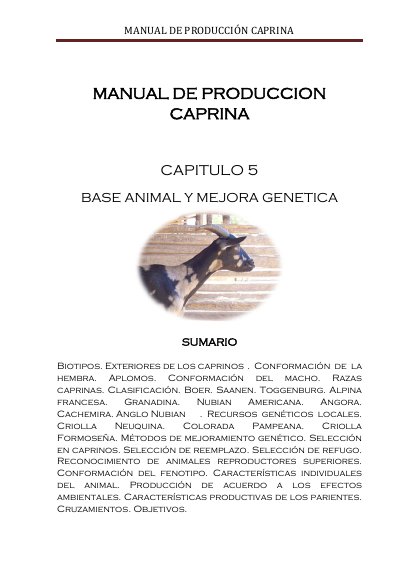
This document serves as a guide for goat production and genetic improvement, focusing on the biological types (biotypes) of goats. It explains the specific morphological and physiological characteristics that define meat-producing, milk-producing, hair-producing, and dual-purpose biotypes. The text emphasizes that these traits determine the efficiency of the animal in producing specific outputs like meat, milk, or fiber. This manual is written in Spanish.
The manual identifies four main biotypes: meat producer, milk producer, intermediate between meat and milk, and a specific type for hair production.
Breeds are classified into four groups based on geographic origin: European, Asian, African, and American.
The globular type is recommended because it is less susceptible to pathologies.