
The present invention relates to novel compositions comprising phosphorescent reporters. In some embodiments, the phosphorescent reporters of the present invention comprise strontium aluminate. In some embodiments, the strontium aluminate is doped with europium and dysprosium (SrAl2O4:Eu2+, Dy3+). Other embodiments of the invention relate to methods for preparing the aforementioned phosphorescent reporters. In some embodiments, the method comprises reducing the size of a phosphorescent powder through a combination of wet milling and sedimentation. In other embodiments, the invention relates to methods for detecting the phosphorescent reporters in various devices, such as diagnostic devices.
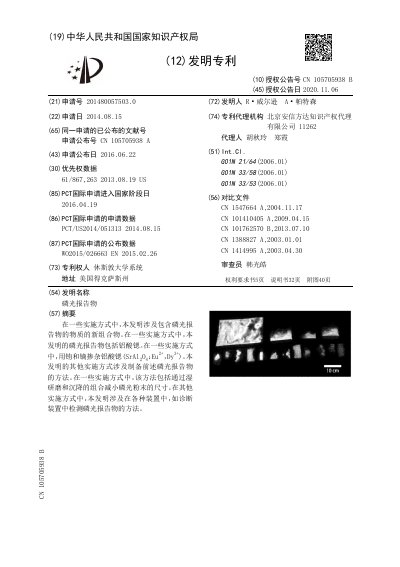
The document is an official grant announcement from the China National Intellectual Property Administration for a patent titled "Phosphorescent Reporters" (CN 105705938 B). It discloses new compositions involving phosphorescent materials, specifically alkaline earth metal aluminates like strontium aluminate doped with europium and dysprosium, for use in diagnostic devices.
The text details the structure of the phosphorescent reporters, which consist of a core of inorganic phosphorescent particles (50nm to 600nm diameter) encapsulated in a shell (such as a silica layer or hydrophilic polymer) and functionalized with molecular recognition parts like antibodies or aptamers. It also describes methods for preparing these reporters, including grinding and settling to reduce particle size, and methods for detecting target analytes using the resulting luminescent signals. This manual is written in Chinese.
It is a persistent luminescent reporter whose core is an inorganic phosphorescent particle, enclosed in a shell and carrying a molecular recognition moiety.
The particles range from 50 nm to 600 nm in diameter.
Antibody, antibody fragment, antigen, nucleic acid, peptide, protein, or aptamer.
It is detected by excitation of the inorganic phosphorescent particles, such as with ultraviolet, visible, or other photons.