
The purpose of this study was to understand the current status of voluntary health checkups in Japan and to provide basic data for the future implementation of voluntary health checkups in Japan.
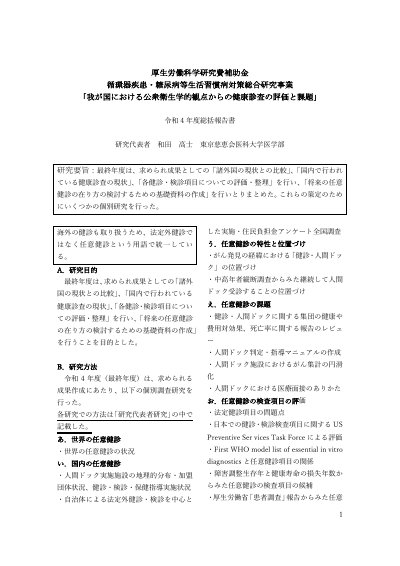
This is a final-year research report funded by a Ministry of Health, Labour and Welfare grant-in-aid and led by Takashi Wada of Tokyo Jikei University School of Medicine. It summarizes work on voluntary health checkups from a public health perspective, including comparisons with other countries, the current domestic situation, evaluation of checkup items, and preparation of basic materials for future voluntary health checkups.
The report includes surveys of human dock facilities and municipal non-statutory checkups, analysis of cancer detection routes and longitudinal survey data, reviews of cost-effectiveness and mortality, and proposals on terminology, requirements for main and option tests, and a minimum human dock program. This manual is written in Japanese.
It compared voluntary health checkups in other countries with Japan, described the current domestic situation, evaluated checkup and screening items, and prepared basic materials for considering future voluntary health checkups.
Human dock subsidies were implemented by 65.5% of municipalities, about two-thirds, despite their high cost.
The median resident cost burden was 11,000 yen for human dock subsidies and 10,000 yen for brain dock subsidies.