
The Nikon 100mm F2.8 Macro D is a versatile lens that can be used as a moderate telephoto or portrait lens. It has a focus-limiting switch that can shorten the focusing time.
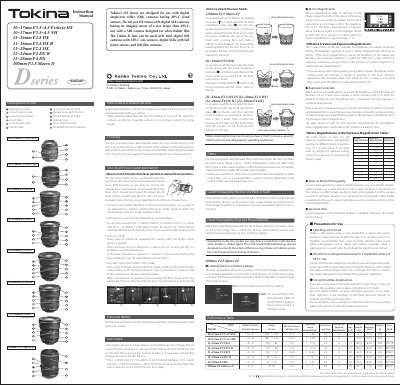
This Tokina instruction manual covers the 100mm F2.8 Macro D lens. It explains the focus-limiting switch, attaching and detaching the lens, filter use, lens hood attachment, and precautions for macro photography.
Macro-specific sections discuss effective F-value, exposure magnification, aperture ring locking, and exposure correction. The page also includes focusing notes, built-in flash cautions, red-eye notes, and a performance table listing the lens.
| Focus range, FULL position | 0.3 m to infinity |
|---|---|
| Focus range, LIMIT position | Approximately 0.38 m to infinity, or approximately 0.3 m to 0.36 m in the macro range |
| Effective F-value at closest focus with lens set to F2.8 | Changes until it reaches F5.6 |
| Aperture ring setting required for shutter release | Minimum aperture (highest F number) |
Set the focus-limiting switch to LIMIT instead of FULL. FULL focuses from 0.3 m to infinity; LIMIT shortens focusing time by locking out the macro range.
The shutter will not release unless the aperture is locked at the minimum setting, which is the highest F number.
The sound comes from ball bearings designed to smooth the focus ring action. It does not indicate a problem with general lens functioning.
No. Use one filter at a time, because stacking filters or using a thick filter such as a polarizer may cause vignetting.