
This leaflet is intended to provide you with general information. It is not a substitute for advice from your ophthalmologist. You are encouraged to discuss the benefits and risks of treatment with your ophthalmologist. This is an abridged version of the RANZCO patient education pamphlet: Blepharitis: a guide for patients. The complete pamphlet with treatment details is available from your ophthalmologist. Blepharitis is inflammation of the margins of the eyelids. Both eyes are usually affected. The condition appears in two forms: anterior (or front) and posterior (or back) of the eyelid margins. The most common cause is bacterial infection in the glands of the eyelids and eyelash follicles. Blepharitis can occur in children and adults of any age. Signs and symptoms include: ■ a feeling of “something in the eye” ■ excessive or frothy tears ■ itchiness ■ excessive blinking ■ photophobia (sensitivity to light) ■ crusty or sticky eyelashes, particularly in the morning. Diagnosis ■ Your ophthalmologist will ask you about your symptoms and carefully examine your eyes. ■ The examination may include a vision test and an assessment with a special microscope called a slit lamp. ■ If the inflammation looks unusual or does not respond to treatment, a laboratory “culture” of the eyelid margin may be needed to identify any bacteria. ■ In rare cases, the ophthalmologist may advise that a biopsy be taken. A tiny piece of the eyelid margin is removed and examined under a microscope. You
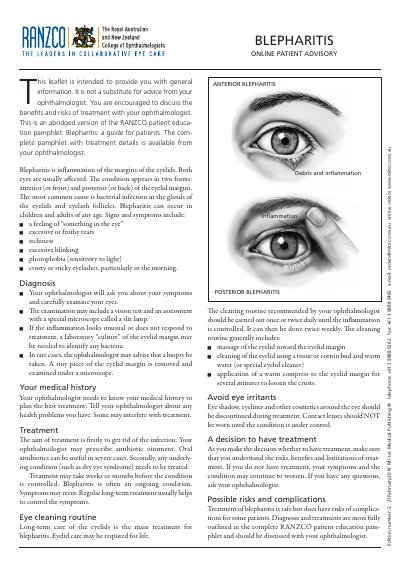
Blepharitis is inflammation of the margins of the eyelids and usually affects both eyes. It appears in anterior or posterior forms and is most commonly caused by bacterial infection in the eyelid glands and eyelash follicles.
The leaflet describes signs and symptoms, diagnosis by an ophthalmologist, treatment options, and an eye cleaning routine. It also advises patients to avoid eye irritants and contact lenses during treatment.
Blepharitis is inflammation of the margins of the eyelids, usually affecting both eyes.
It should be carried out once or twice daily until the inflammation is controlled, then twice weekly.
No, contact lenses should not be worn until the condition is under control.
Yes, blepharitis is often ongoing and symptoms may recur.