
This brief is about focus groups as a data collection method for evaluation. It includes a basic overview of focus groups, when to use them, how to plan and conduct them, and their advantages and disadvantages.
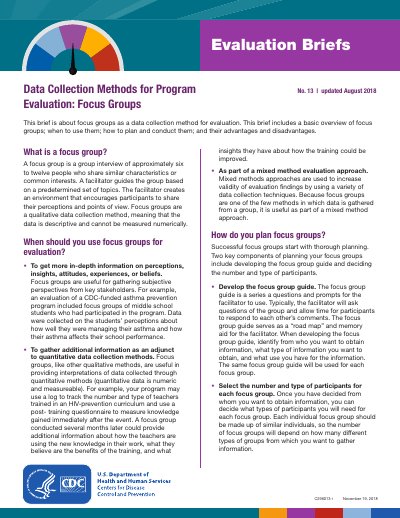
This two-page CDC Evaluation Briefs document (No. 13, updated August 2018) describes focus groups as a data collection method for program evaluation. It gives a basic overview of focus groups, explains when to use them, how to plan and conduct them, and lists their advantages and disadvantages.
A focus group is defined as a group interview of approximately six to twelve people who share similar characteristics or common interests, guided by a facilitator using a predetermined set of topics. The brief covers developing the focus group guide, selecting the number and type of participants, the roles of facilitator, note taker and technician, conducting sessions in person, by phone or by web conference in about 60 to 90 minutes, and ends with a list of resources and CDC contact information.
| Typical focus group size | Approximately six to twelve people |
|---|---|
| Typical focus group duration | About 60 to 90 minutes |
It is a group interview of approximately six to twelve people who share similar characteristics or common interests, guided by a facilitator using a predetermined set of topics.
To get more in-depth information on perceptions, insights, attitudes, experiences or beliefs, to gather information alongside quantitative methods, or as part of a mixed method evaluation approach.
A facilitator who guides the discussion, a note taker who observes without interacting, and a technician responsible for recording the session.
They are susceptible to facilitator bias, the discussion can be dominated or sidetracked by a few individuals, analysis is time consuming, and the information is not valid at the individual level or representative of other groups.