
The utility model relates to a high-precision fixture device, and in particular to a processing device for a morse taper shank tool. The purpose of the utility model is to provide a morse taper shank tool processing device which is easy to clamp, has a constant positioning dimension, is easy to process after fire, and has high processing accuracy.
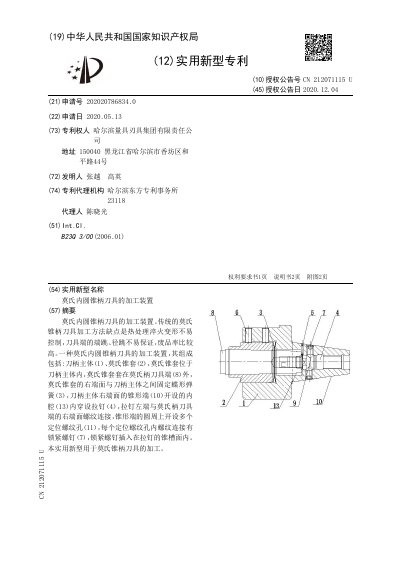
This is Chinese utility model patent CN 212071115 U, filed on 2020-05-13 and published on 2020-12-04, with Harbin Measuring & Cutting Tool Group Co., Ltd. as patentee and Zhang Yue and Gao Ying as inventors. It describes a high-precision fixture for machining Morse inner-taper shank tools: a tool shank body, a Morse taper sleeve inside it, a disc spring fixed between the sleeve's right end face and the body, a pull stud passed through the cavity opened in the conical end of the body, and locking screws threaded into locating threaded holes on the conical end that are inserted into the conical groove face of the pull stud.
A fastening screw in a fixing threaded hole on the flat side of the cylindrical end clamps the flat side of the Morse taper sleeve, and a cylindrical pin inserted in a round hole of the conical end positions the tool end axially. Because the shank body and the Morse taper sleeve are split parts, only the sleeve and pull stud need to be changed for a different Morse taper number; the patent states this reduces repeated shank-body changes and measuring-baseline errors, and makes clamping convenient with constant locating dimensions, which suits machining after heat treatment. The background notes that Morse tapers are divided into numbers 0 to 6. This manual is written in Chinese.
| Morse taper numbers | No. 0 to No. 6 |
|---|---|
| Main parts (drawing reference list) | Tool shank body, Morse taper sleeve, disc spring, pull stud, cylindrical pin, fastening screw, locking screw |
| Structure type | Split design of shank body and Morse taper sleeve |
It is intended as a clamping fixture that is easy to load, has constant locating dimensions, allows machining after heat treatment and provides high precision.
The patent states that heat-treatment quenching deformation is hard to control and the end runout and radial runout of the tool end are hard to guarantee, giving a high reject rate.
No. Only the Morse taper sleeve needs to be replaced; the shank body does not have to be changed.
A fastening screw threaded into a fixing threaded hole on the side of the shank body's cylindrical end presses its bottom face onto the flat side of the Morse taper sleeve.