
The utility model proposes a multi stack fuel cell cooling system, which can recover and utilize the waste heat of the front-end fuel cell stack, and can realize the rapid start-up of the back-end fuel cell without consuming additional electric energy, thus improving the energy utilization rate of the system.
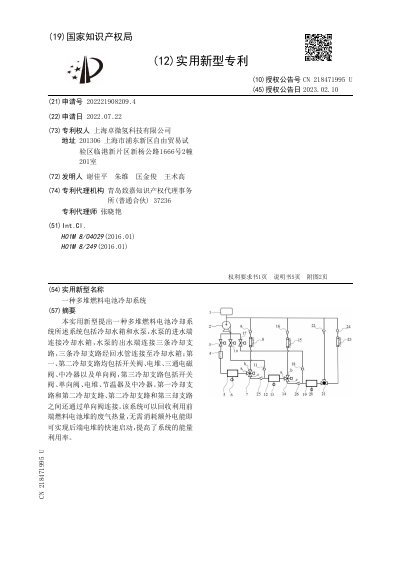
This document is the granted Chinese utility model patent CN 218471995 U, titled 多堆燃料电池冷却系统 (multi-stack fuel cell cooling system), owned by Shanghai Zhuowei Hydrogen Technology Co., Ltd. (上海卓微氢科技有限公司). The patent was filed on 2022-07-22 and announced on 2023-02-10, and contains one page of claims, five pages of description and two pages of drawings.
The claimed system consists of a cooling water tank and a pump whose outlet feeds three cooling branches connected back to the tank through a return pipe. The branches include switch valves, fuel cell stacks, three-way solenoid valves, intercoolers, check valves, a PTC heater, a thermostat and temperature sensors, all electrically connected to a fuel cell controller. By routing coolant so that waste heat from the upstream stacks preheats the downstream stacks, the rear stacks can be started quickly without consuming extra electric energy, which the patent states improves the energy utilization of the system. This manual is written in Chinese.
| Cooling branches | 3 |
|---|---|
| Stack temperature sensors | One temperature sensor per stack (three total) |
| Fuel cell controller | Connected to the three stacks, pump, PTC heater, temperature sensors, switch valves and three-way solenoid valves |
The recovered waste heat preheats the rear stacks so they can be started quickly without consuming extra electric energy, improving the system's energy utilization.
According to the patent's background section, an unpreheated fuel cell cold start in cold environments takes 2–5 minutes.
The first cooling branch connects, in order, a switch valve, a PTC heater, stack one, a three-way solenoid valve, an intercooler and a check valve, with a temperature sensor on the stack.
The patent includes a structural diagram of the system, a control network connection diagram, and a logic judgment diagram of the method of use.