
The invention provides a polishing process for aviation metal materials, which can effectively eliminate the scratches on the surface of difficult-to-machine metal materials, greatly improve the gloss of the metal surface after polishing, and improve the quality of metal products.
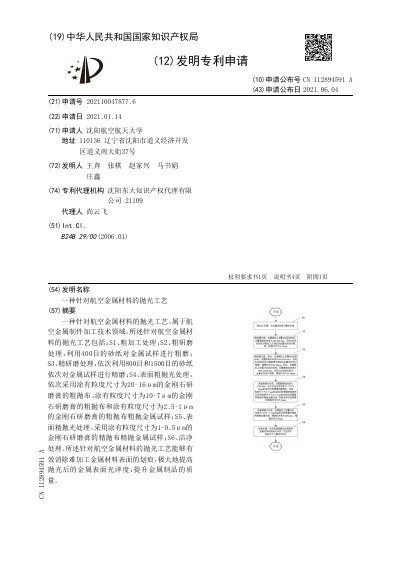
The document details a specific six-step polishing process designed for aviation metal materials, such as titanium alloys and high-temperature alloys. The process aims to eliminate surface scratches and significantly increase surface gloss to facilitate subsequent microscopic inspection.
The procedure involves initial rough processing and embedding, followed by coarse and fine grinding using sandpaper of specific grits (400, 800, and 1500) at defined machine speeds. The final stages include coarse and fine polishing using diamond polishing pastes with varying particle sizes (ranging from 20-16μm down to 1-0.5μm) and a final cleaning step involving water rinsing and drying or sealing with anhydrous ethanol. This manual is written in Chinese.
| Coarse grinding paper grit | 400 mesh |
|---|---|
| Fine grinding paper grits | 800 mesh and 1500 mesh |
| Coarse polishing paste particle size | 20-16μm, 10-7μm, 2.5-1μm |
| Fine polishing paste particle size | 1-0.5μm |
| Coarse grinding machine speed | 400-600 r/min |
| Fine grinding machine speed (800 mesh) | 800-900 r/min |
| Fine grinding machine speed (1500 mesh) | 1000-1200 r/min |
| Coarse polishing machine speed | 150 r/min |
| Fine polishing machine speed | 200 r/min |
| Diamond wire feed speed | 0.1-1 mm/min |
The process is designed for aviation metal materials, including titanium alloys, high-temperature alloys, and aluminum alloys.
The process effectively eliminates scratches on the surface of difficult-to-machine metal materials and greatly improves the gloss of the polished metal surface.
If the metal sample is prone to oxidation, it should be sealed with anhydrous ethanol after rinsing with water.