
This document is about the product manual of COMBI-LINE self-service models, which has 9 models: CB 1x 5, CB 1x10, CB 1x20, CB 2x 5, CB 2x10, CB 2x20, CB 1x5 R, CB 1x10 R and CB 1x20 R.
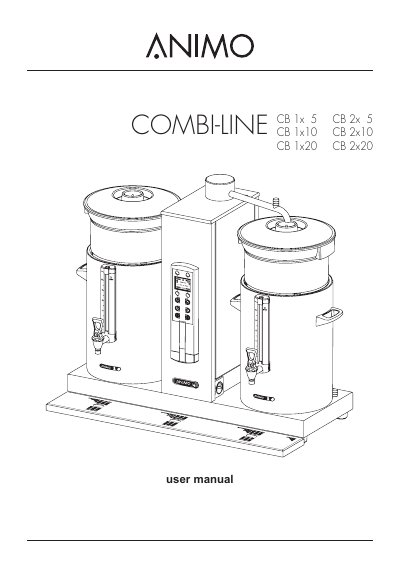
This user manual covers the Animo ComBi-line self-service coffee machine models CB 1x5, CB 1x10, CB 1x20 (left and right versions) and CB 2x5, CB 2x10, CB 2x20. It is written for qualified staff who install, operate and maintain the equipment, and for trained personnel who access the PIN-protected operation menu or perform repairs.
The manual contains safety instructions and hazard warnings, technical specifications, installation steps (unpacking, water connection, drainage, electrical connection), first-use procedures, control panel descriptions, daily use of coffee and tea brewing, cleaning and descaling schedules, temperature protection, transport notes and a list of consumer items and accessories. The machine is intended only for brewing coffee and/or tea; the document is multilingual, with Dutch, German, English and French sections.
| Brew time (water fill time) | approx. 10 min / 5 L (CB 5), approx. 10 min / 10 L (CB 10), approx. 14 min / 20 L (CB 20) |
|---|---|
| Hourly capacity (water) | 30 L (CB 5), 60 L (CB 10), 90 L (CB 20) |
| Buffer reserve | 10 L (CB 5), 20 L (CB 10), 40 L (CB 20) |
| Container capacity | CN5e 5 L (max 5.5 L), CN10e 10 L (max 11 L), CN20e 20 L (max 22 L) |
| Container power | 35 W (CN5e), 70 W (CN10e and CN20e) |
| Electrical system | 1N~ 220-240 V 50-60 Hz 3200 W; 3N~ 380-415 V 50-60 Hz 6200 W or 9200 W |
| Water connection | swivel 3/4" outer thread, min. pressure 0.02 MPa (0.2 bar), max. 1 MPa (10 bar), flow 5 l/min |
| Water hardness | min. 5° dH (min. 9° fH, 0.9 mmol/l) |
| Weight (2x models) | empty 30/39/50 kg, filled 40/59/90 kg |
| Transport dimensions (2x models) | 865x495x745 mm, 995x495x845 mm, 1120x520x1080 mm |
The machine is only for brewing coffee and/or tea; using it for any other purpose may create hazards, and the manufacturer accepts no liability for damage from misuse.
The machine only runs when the swivel arm and container are correctly positioned; if they move out of place during operation, the process stops immediately, a symbol appears on the display and a short double audio signal sounds.
Failure to descale the heating system on time leads to high repair costs and voids the warranty; the most common cause of dry-boil protection tripping is a heating system that has not been descaled in time.
Installation may only be carried out by a qualified service engineer, and all repair work must be done by qualified technical personnel.