
The value of talent development programs, aimed at nurturing children and adolescents into high performance sport, has been widely questioned. However, there seems to be some agreement that the general concept of talent development is not the issue; rather, the problems exist in the design, implementation, and management of these systems.
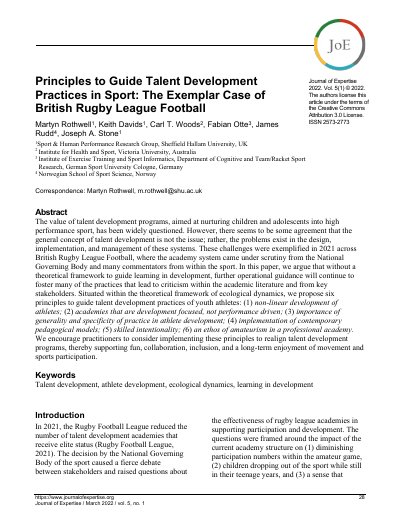
This is a scholarly opinion article by Martyn Rothwell, Keith Davids, Carl T. Woods, Fabian Otte, James Rudd and Joseph A. Stone, published in the Journal of Expertise (March 2022, vol. 5, no. 1). The authors, affiliated with Sheffield Hallam University, Victoria University, the German Sport University Cologne and the Norwegian School of Sport Science, examine criticism of talent development programs, exemplified in 2021 when the Rugby Football League reduced the number of academies receiving elite status.
Writing from an ecological dynamics perspective (the combination of ecological psychology and dynamical systems theory), the authors propose six principles to guide talent development practices of youth athletes: non-linear development of athletes; academies that are development focused, not performance driven; the importance of generality and specificity of practice; implementation of contemporary pedagogical models; skilled intentionality; and an ethos of amateurism in a professional academy. They argue these principles can support fun, collaboration, inclusion and long-term enjoyment of movement and sports participation.
The six principles are: non-linear development of athletes; academies that are development focused, not performance driven; importance of generality and specificity of practice; implementation of contemporary pedagogical models; skilled intentionality; and an ethos of amateurism in a professional academy.
The article describes ecological dynamics as the combination of ecological psychology and dynamical systems theory, used as a framework to guide talent development pathways.
In 2021 the Rugby Football League reduced the number of talent development academies receiving elite status, which raised questions about the effectiveness of academies in supporting participation and development, including dropping participation numbers and teenagers leaving the sport.