
The study showed that preoperative planning is effective in primary total knee arthroplasty.
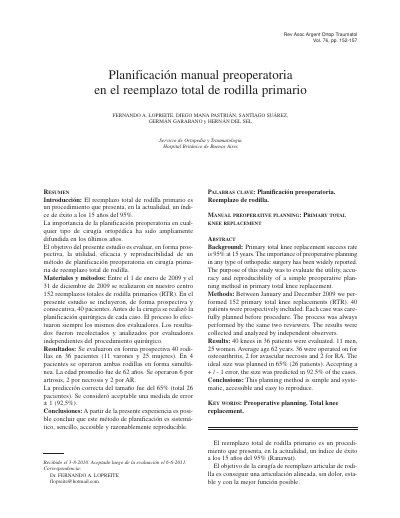
This is a Spanish-language clinical article by Fernando A. Lopreite and colleagues from the Orthopedics and Traumatology Service of Hospital Británico de Buenos Aires, published in Revista de la Asociación Argentina de Ortopedia y Traumatología (Vol. 76, No. 2, June 2011, pp. 152-157). It prospectively evaluates a manual preoperative planning method for primary total knee replacement, a procedure reported to have a 95% success rate at 15 years.
Between January and December 2009 the authors planned 40 knees in 36 patients (average age 62 years) operated on for osteoarthritis, avascular necrosis or rheumatoid arthritis. Planning used anteroposterior and lateral radiographs taken at one meter plus an axial patellar view, with plastic goniometers and the implant's original acetate templates (PFC Sigma system, DePuy). The exact component size was predicted in 65% of cases, and within ±1 size in 92.5%; the authors conclude the method is systematic, simple, accessible and reasonably reproducible. This manual is written in Spanish.
The ideal size was planned correctly in 65% of cases (26 patients), and accepting an error of ±1 size, prediction was correct in 92.5% of cases.
40 knees in 36 patients were evaluated prospectively; 4 patients had both knees operated on simultaneously.
All cases used imported DePuy (Leeds, UK) implants, most commonly the modular PFC Sigma prosthesis (60% of cases), with all-polyethylene tibial trays in 15 cases and one constrained TC3 implant.
Strict anteroposterior and lateral radiographs taken at one meter, with the AP view under weight bearing, plus an axial patellar view with the knee flexed 30 degrees.