
EX series electric actuators are modular in design and have advantages such as high cost effectiveness, strong optionality and convenient operation and maintenance.
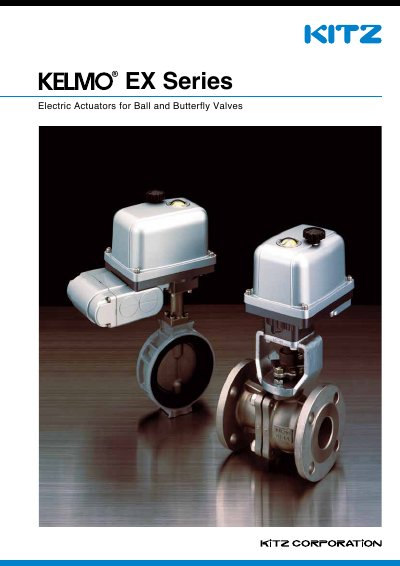
This document introduces the KITZ KELMO' EX Series electric actuators for ball and butterfly valves. The series comprises the EXH high-speed actuator for ball valves and the EXS standard-speed actuator for ball and butterfly valves, both built with modular construction and common parts, with sizes from EXH/EXS100/200-1 through -5.
The pages describe features such as the manual override handle with interlock switch, position indicator, adjustable cams with standard and auxiliary limit switches, stainless steel exterior bolting and a planetary output reduction gear. It also lists optional specifications (power supply voltages, potentiometer output, relays, terminal boxes and conduit ports), a specification table for the EXH100/200 and EXS100/200 models, a circuit diagram with limit switch timing, the product code system and overall dimensions.
| Power supply | 100/200 V AC +10%, 50/60 Hz |
|---|---|
| Output torque | 9.8 to 1000 Nm depending on size |
| Motor type | Reversible |
| Motor output (rating) | 16 to 85 W |
| Duty factor | 30% ED |
| Position limit switch | Two switches with no supplied voltage |
| Switch contact voltage | 250 V AC, 2 A |
| Insulation class | JIS Glass E |
| Overload protection | Thermal protection |
| Waterproof and dustproof | Equivalent to IP 67 |
| Ambient temperature | From -10°C to +50°C |
| Mounting flange | Meets ISO 5211 |
EXH is a high-speed actuator for ball valves, while EXS is a standard-speed actuator for ball and butterfly valves.
Pull up the manual override handle knob for manual operation, which activates the built-in interlock switch to cut off the power supply. Push the knob down to restore electrical operation.
Besides the standard 100/200 V supply, optional supplies include AC 110, 115, 120, 220, 230 and 240 V at 50/60 Hz.
They are rated for indoor or outdoor service in ambient temperatures from -10°C to +50°C, but submergence and direct sunlight must be avoided.