
The UNIPHOS-500DT is a digital transmitter with 4-20mA loop installation and relay cable guideline.
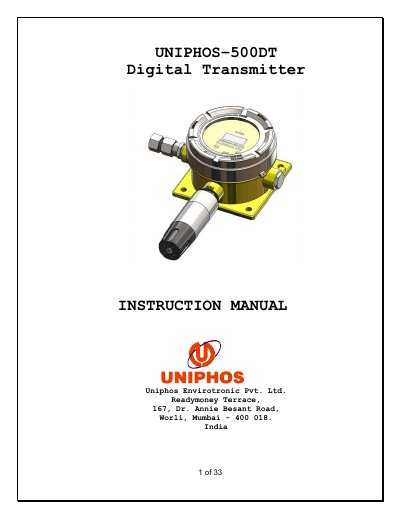
The UNIPHOS-500DT is a digital gas transmitter from Uniphos Envirotronic Pvt. Ltd. that provides continuous monitoring of flammable, toxic and Oxygen gas hazards in the workplace, both indoors and outdoors. It uses plug-in sensor modules for a variety of gases and provides a 4-20 mA output signal that can be connected to control systems such as DCS or PLC.
This instruction manual covers selecting a location, mounting and wiring the transmitter, operating the LCD/OLED display and magnetic switches, calibration procedures, maintenance of the sensor, and a troubleshooting guide. It also includes specifications and a list of available gas sensors with their ranges.
| Output signal | 4-20 mA, connectable to DCS, PLC etc. |
|---|---|
| Enclosure | Certified Explosion proof (Exd) with 3 cable entry openings |
| Cable entries | 1/2" NPT / M20 conduit fitting outlets |
| Maximum cable resistance | 600 ohm less the controller resistance |
| Sensor types | Electrochemical and NDIR sensor modules |
| Oxygen sensor range | 0-25 % V/V, resolution 0.1 % V/V |
| Carbon Monoxide sensor range | 0-1000 PPM, resolution 1 PPM |
| Hydrogen Sulphide sensor range | 0-100 PPM, resolution 1 PPM |
Yes, relay operation, alarm set points and date/time can be adjusted using the transmitter's LCD/OLED and non-intrusive magnetic switches.
On activation of the power supply, within a few seconds it recognizes the plugged-in sensor, tests it and resumes operation; incompatible sensors are detected and prompted on the display.
Yes, outputs are automatically inhibited during adjustments, reducing the risk of false alarms at the control panel during maintenance.
Yes, plug-in sensor replacement is an extremely easy operation, but KwikSense-Lite swappability is limited only to the same gas and its variant.