
This document is a guideline for the interventional treatment of urolithiasis. It introduces the definition, epidemiology, etiology, diagnosis and treatment of urolithiasis.
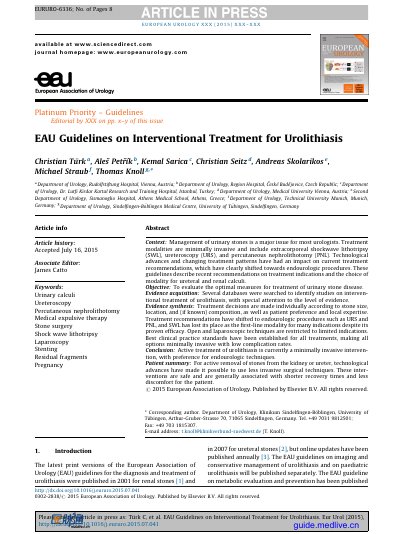
This document is the European Association of Urology (EAU) Guidelines on Interventional Treatment for Urolithiasis, an article accepted in July 2015 for the journal European Urology. It was written by a panel of urologists from hospitals and universities in Austria, the Czech Republic, Turkey, Greece, and Germany, and updates the EAU's earlier print guidelines on renal stones (2001) and ureteral stones (2007).
The guideline covers indications for active stone removal and the selection of treatment procedures for upper urinary tract stones. Treatment decisions are made individually according to stone size, location, and (if known) composition, as well as patient preference and local expertise. Recommendations have shifted toward endourologic procedures such as ureteroscopy (URS) and percutaneous nephrolithotomy (PNL), while shockwave lithotripsy (SWL) has lost its place as the first-line modality for many indications, and open or laparoscopic techniques are restricted to limited indications.
Shockwave lithotripsy (SWL), percutaneous nephrolithotomy (PNL), and ureteroscopy (URS) are listed as suitable treatment modalities for renal calculi.
The guideline recommends that stones larger than 2 cm should be treated by PNL.
Indications include a low likelihood of spontaneous passage, persistent pain despite adequate analgesia, persistent obstruction, and renal insufficiency.
No. Recommendations have shifted to endourologic procedures such as URS and PNL, and SWL has lost its place as the first-line modality for many indications.